The Chemical Inventory Gap: Why Print Shop HazCom Programs Fall Behind
Most print shop owners can point to their Hazard Communication binder, but the binder isn't the program. The program is whether the chemical inventory, safety data sheet (SDS) library, container labels, and employee training all describe the same chemicals your team actually uses this week.
In a print shop, that alignment is unusually hard to maintain, not because owners are careless, but because the chemistry changes faster than the paperwork. A new press wash replaces an old cleaner, a supplier reformulates an ink, a rush job brings in a specialty coating, or a squeeze bottle gets filled at the press and set down without a label.
Every one of those is a purchasing or shop-floor decision made in seconds, while the update to the Hazard Communication Standard (HazCom) program that should follow it often happens later, if at all. That gap between how fast the inventory moves and how slowly the safety program catches up is where most print shop HazCom problems live. This article explains why that gap forms, where it shows up, and what a HazCom program that keeps pace actually looks like.
Why HazCom Is Harder in a Print Shop Than in Most Workplaces
Hazard Communication applies to any workplace where employees can be exposed to hazardous chemicals, and it remains one of the most cited standards in the country. In fiscal year 2025, it was the second most frequently cited Occupational Safety and Health Administration (OSHA) standard across all industries, and it is a general-industry standard that applies squarely to print shops (1). That ranking is not evidence that employers do not care. It is evidence that HazCom is genuinely difficult to keep current in operations where chemicals change often. Print shops can experience frequent changes in the chemicals used across processes, departments, and shifts.
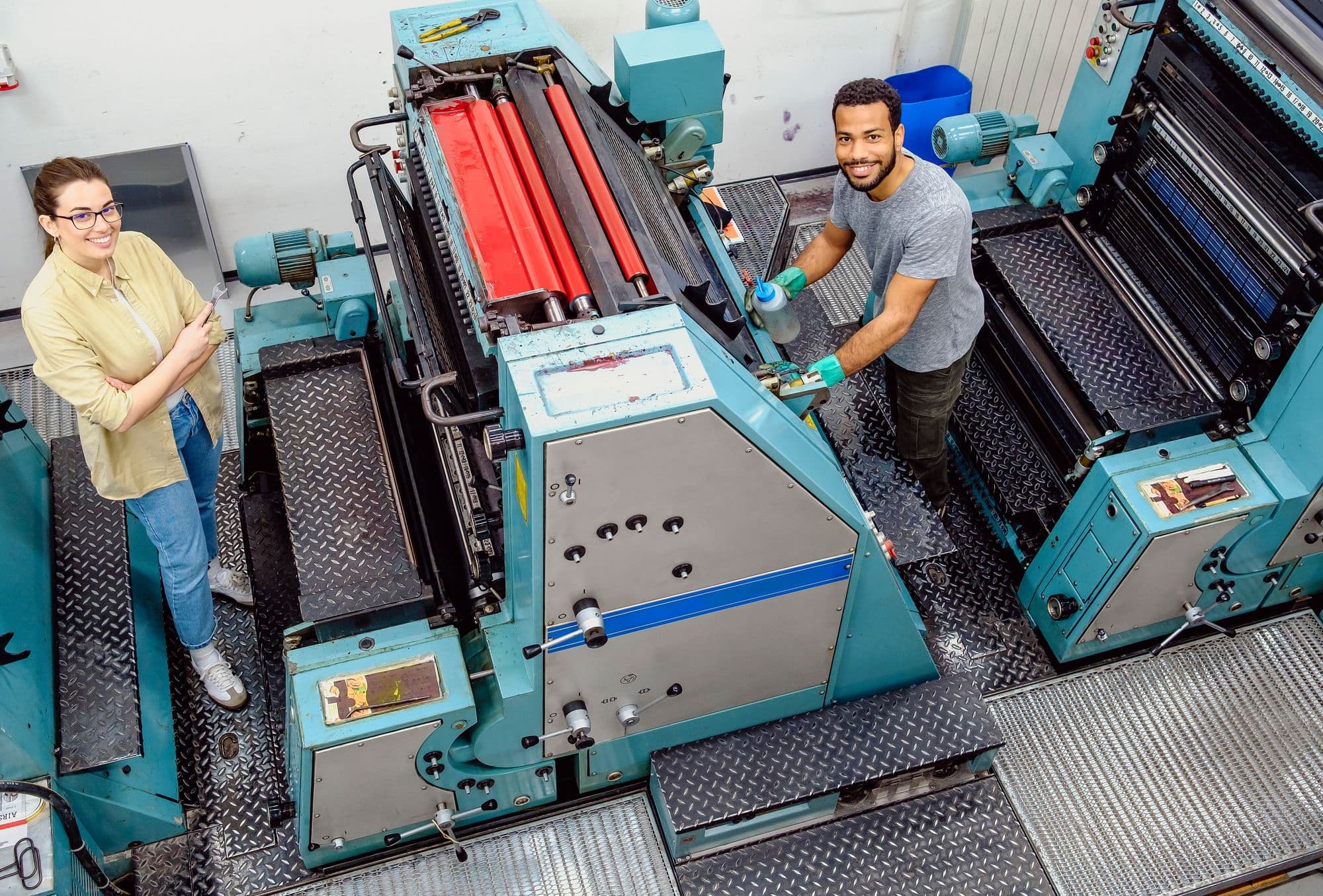
Consider how many distinct chemical products move through a typical operation. Offset lithography runs on fountain solutions, blanket and roller washes, plate cleaners, inks, and coatings. Flexography adds fast-drying liquid inks, anilox cleaners, and adhesives. Screen printing brings inks, emulsions, reclaiming chemicals, and cleaning solvents. Digital and wide-format work introduces UV inks and coatings, laminates, and specialty fluids. Then add the products that do not belong to any one process: maintenance chemicals, aerosols, thinners, and the waste inks and solvent-soaked wipes that accumulate at the end of every shift.
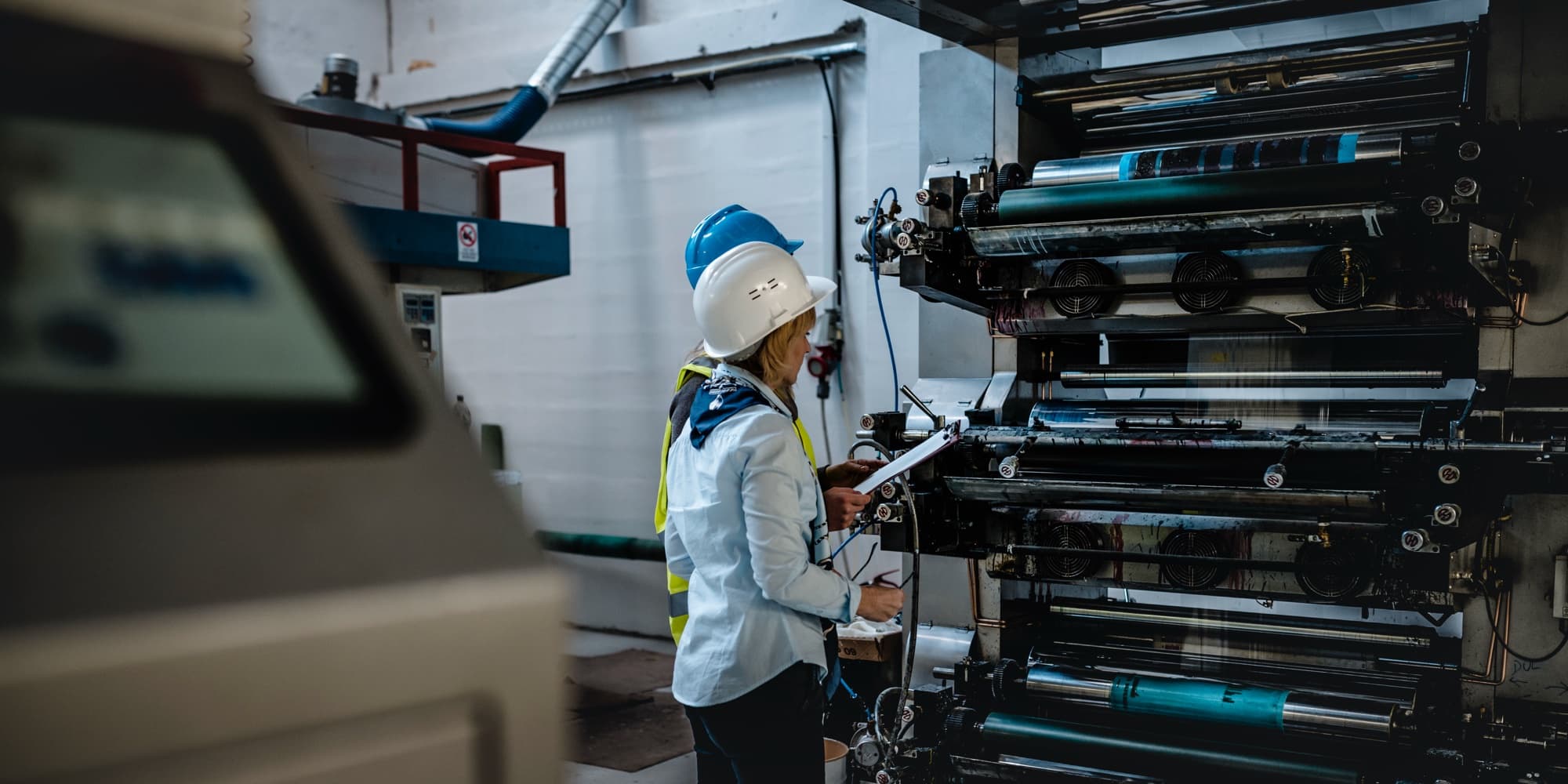
These exposures can be significant. The National Institute for Occupational Safety and Health (NIOSH) has noted that press operators can be exposed to airborne solvent vapors during press cleaning, that press-cleaning solutions are typically mixtures of several solvents, some of which are carcinogenic and can be absorbed through the skin, and that small shops in particular often have excessive exposures where ventilation and other controls are inadequate (2). This is exactly why a generic chemical-safety approach does not work in a print shop. The hazards are specific to the products in use, and the products in use change.
Where the Inventory Gap Shows Up
When a HazCom program falls behind, it rarely announces itself. It shows up in four quiet places.
The chemical inventory becomes incomplete. Purchasing adds a product without telling whoever owns the safety program, a discontinued product stays in the binder while its replacement doesn't, and the inventory slowly becomes a record of what the shop used to use rather than what it uses now.
The SDS library turns into an archive, full of sheets for products no longer on the floor and missing sheets for products that just arrived. OSHA requires an SDS to be readily accessible during every shift (3), and a library fails that test if a night-shift operator can't quickly find the right sheet, whether because of an unfamiliar supplier name, a login only managers have, or a network that's down.
Secondary containers lose their labels. Print shops constantly transfer chemicals into squeeze bottles and press-side containers. The immediate-use exception is narrow. It applies when the chemical remains under the control of the employee who transferred it and is used within that work shift. Containers outside that exception generally need workplace labeling that meets the applicable standard (3).
Training stops matching the chemicals. OSHA requires training at initial assignment and whenever a new hazard is introduced (3). The usual gap isn't that employees were never trained. It's that training stopped keeping pace with the inventory, and multi-shift operations make it worse, since day shift often gets the walkthrough while maintenance and night-shift staff don't.
The 2024 HazCom Update: A Timely Reason to Review, Not a Deadline to Panic Over
OSHA updated the Hazard Communication Standard in a final rule effective July 19, 2024, aligning it primarily with the seventh revision of the Globally Harmonized System of Classification and Labelling of Chemicals (GHS). The update kept the familiar structure, a written program, the 16-section SDS, labels, and training, while revising hazard-classification criteria, small-container labeling, and other provisions (4).
For a print shop, the detail that matters most is the distinction between substances and mixtures. Substances must be brought into compliance by May 19, 2026, with employer updates due by November 20, 2026, while mixtures follow a later track, compliant by November 19, 2027, with employer updates due by May 19, 2028 (5). During the transition, employers may comply with the 2012 version, the 2024 version, or both, which is why a shop's library legitimately contains a mix of old and new sheets right now.
This distinction matters because many inks, coatings, washes, fountain solutions, and adhesives are mixtures, so a substantial portion of a print shop's inventory may follow the later timeline. Each product still needs to be classified and reviewed based on its current safety data sheet. The mistake to avoid is telling your team "everything must be updated by 2026." The sensible move is to begin the review now, so your substance-based products and mixtures are handled on their correct timelines rather than compressed against a deadline.
What a Print Shop HazCom Program That Keeps Pace Looks Like
The common thread across every gap above is timing: the program lags the inventory. A HazCom program that keeps pace is one where a chemical change triggers the safety update automatically, rather than waiting for someone to notice. In practice, that means:
- A purchasing review so new products are vetted before they reach the floor, feeding a chemical inventory tracked by department
- An SDS library tied to actual label identifiers, accessible on every shift, with an offline backup
- A consistent secondary-container labeling method, with the immediate-use exception applied correctly
- Training that updates with new hazards and reaches every shift and role, plus a process for retaining required exposure information and records in accordance with applicable requirements (6)
The goal is a program in which the inventory, the SDS library, the labels, and the training all tell the same story about the same chemicals.
How GMG EnviroSafe Helps
Most print shop HazCom gaps aren't failures of effort. They're the predictable result of a fast-moving inventory outpacing a program that isn't updated at the same pace. Closing that gap is the work GMG EnviroSafe does with print operations.
As an EHS compliance partner to the printing industry, GMG helps shops move from a binder that describes the past to a program that keeps up with the present. That work commonly includes:
- Reviewing and updating the chemical inventory to better reflect products used across relevant departments and shifts
- Cleaning up the SDS library and establishing a secondary-container labeling system the floor can actually maintain
- Delivering task-specific Hazard Communication training tied to the chemicals employees handle now, updated as the inventory changes
- Preparing the program for the 2024 HazCom update and keeping the system documented and inspection-ready
The value isn't a thicker binder. It's a HazCom program where the inventory, SDS library, labels, and training stay aligned with what your team actually uses. If you would like a clearer picture of where your HazCom program stands, contact GMG EnviroSafe to discuss your chemical inventory, safety data sheets, labels, and training.
Sources
- OSHA. Top 10 Most Frequently Cited Standards, Fiscal Year 2025. osha.gov
- National Institute for Occupational Safety and Health. Controlling Cleaning-Solvent Vapors at Small Printers, Publication No. 98-107. cdc.gov/niosh
- OSHA. 29 CFR 1910.1200, Hazard Communication. osha.gov
- OSHA. Hazard Communication Standard Final Rule. osha.gov
- OSHA. 29 CFR 1910.1200(j), Hazard Communication compliance dates (osha.gov); and Federal Register, Hazard Communication Standard compliance-date extension, January 15, 2026 (federalregister.gov).
- OSHA. 29 CFR 1910.1020, Access to Employee Exposure and Medical Records. osha.gov