Machine Guarding on Bindery and Finishing Equipment: What OSHA Expects and What Gets Missed
A bindery operator may interact with the same machine in several ways during one job. Feeding stock, removing finished pieces, clearing trim, correcting a misfeed, adjusting a guide, and changing a blade can place the employee near different hazards. The control that fits one task may be wrong for the next.
That is why a machine review should begin with the employee’s intervention. Identify what the person does, where the person can reach, what can move, and whether the machine is producing or being serviced. Those facts determine whether the immediate issue is machine guarding, hazardous-energy control, or a narrowly available alternative for minor servicing.
Follow the employee’s hands through the task
Under 29 CFR 1910.212, employers must use one or more guarding methods to protect operators and other employees from hazards such as the point of operation, ingoing nip points, rotating parts, flying chips, and sparks. When the point of operation exposes an employee to injury, the guard or safeguarding device must prevent the operator from placing any part of the body in the danger zone during the operating cycle.
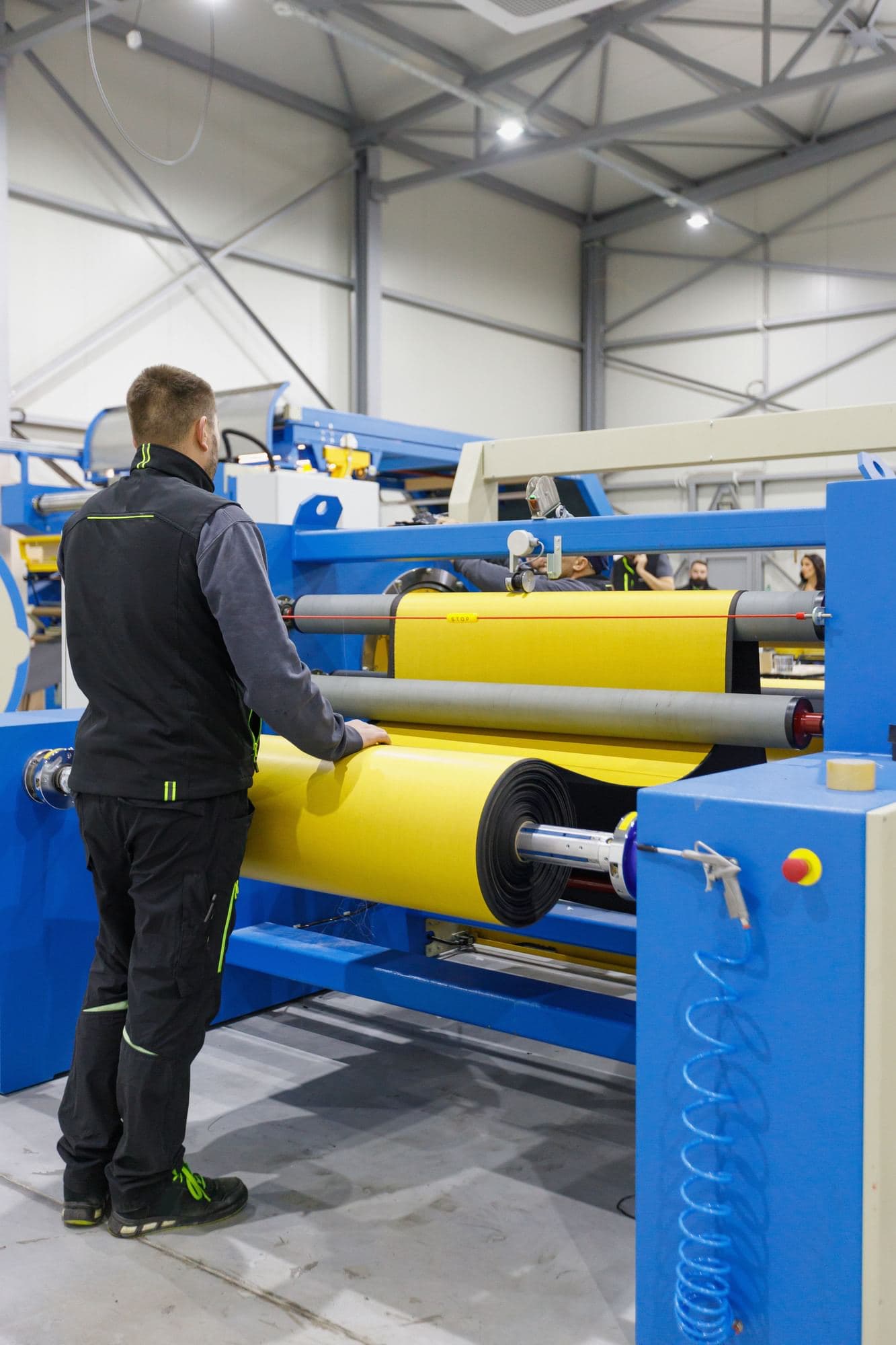
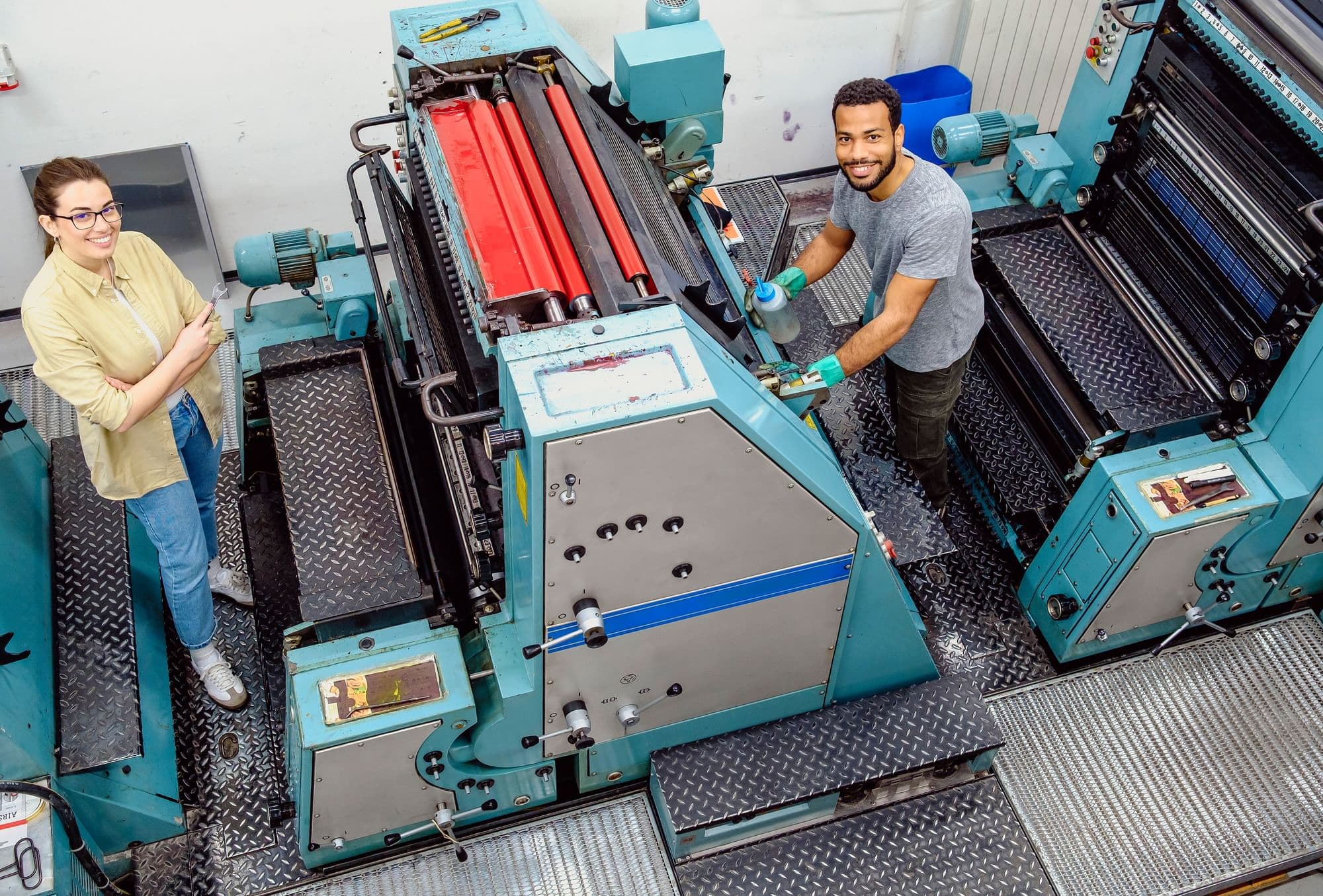
For bindery and finishing equipment, that review should include the feed, delivery, drive side, waste opening, transfer point, underside, and any place an employee reaches during setup or correction. OSHA identifies guillotine cutters as machines that usually require point-of-operation guarding. Hand tools may supplement guarding, but they do not replace a guard required by the standard. Guards must be affixed to the machine where possible and secured elsewhere when attachment to the machine is not possible. They must not create a hazard of their own. Fixed machinery must also be securely anchored to prevent movement.
Power-transmission components require a more specific check. Where 29 CFR 1910.219 applies, it addresses covered shafts, pulleys, belts, gears, sprockets, chains, projecting parts, and related apparatus. It includes component-specific criteria and exceptions, so the machine’s actual arrangement controls the answer. The standard also requires covered power-transmission equipment to be inspected at intervals of no more than 60 days and kept in good working condition. That interval should not be presented as a universal inspection rule for every part of every bindery machine.
Classify the intervention before choosing the control
Normal production and servicing are different operating states. Machine guarding generally protects employees while equipment performs its production function. The lockout/tagout standard, 29 CFR 1910.147, applies to covered servicing and maintenance when unexpected energization, startup, or release of stored energy could injure an employee.
Servicing performed during production can also fall under 1910.147 when an employee removes or bypasses a guard or places any part of the body into the point of operation or an associated danger zone during the operating cycle. Cleaning, unjamming, setup, adjustment, inspection, modification, lubrication, and tool changes can qualify as servicing when that hazardous-energy exposure exists.
Pressing Stop does not establish energy isolation. OSHA’s definition of an energy-isolating device excludes push buttons, selector switches, and other control-circuit devices. A machine may retain electrical, pneumatic, hydraulic, mechanical, gravitational, spring, thermal, or other stored energy after motion stops.
When 1910.147 applies, the energy-control procedure must address shutdown, isolation, lockout or tagout, control of stored or residual energy, and verification that isolation and deenergization have been accomplished before work begins.
Treat the minor-servicing exception as a narrow path
The minor-servicing exception applies only during normal production operations. The activity must be routine, repetitive, and integral to production, and the employer must use alternative measures that provide effective protection. A short task, a familiar jam, an experienced employee, a jog setting, or a stop button does not establish that the exception applies.
OSHA’s April 7, 2004 printing-industry interpretation helps explain this boundary, but its conclusions depend on the tasks and controls described in the letter. OSHA stated that a normal blade change on a guillotine paper cutter would not qualify for the exception and would require an energy-control procedure. OSHA also described how an inch-safe-service technique may provide effective alternative protection for qualifying minor servicing on binding and finishing equipment with appropriate control systems.
That interpretation is not a universal approval for jog or inch mode. OSHA’s described sequence requires stopping the machine and placing it in the Stop/Safe position before servicing, performing a pre-startup check before inching, using controlled movement only for positioning, and returning to Stop/Safe before servicing resumes. The letter also explains that simple push buttons or selector switches alone may not provide effective protection. OSHA did not adopt ANSI B65 as an OSHA regulation or conclude that compliance with ANSI B65 protects employees in every situation.
Recheck safeguards when the work changes
A guard or device should be judged by the exposure it controls, not by its label. A cover may leave a reachable opening. An interlock may be damaged or bypassed. A light curtain or other presence-sensing device may depend on equipment-specific stopping performance and separation distance. A two-hand control may protect one operator without addressing another employee’s access. An emergency-stop device responds after someone recognizes a hazard and activates it; it is not automatically a machine safeguard or an energy-isolating device.
Changes to stock size, conveyors, sensors, controls, speed, waste handling, or guarding can alter reach, visibility, stopping behavior, and access to the danger zone. Recurring workarounds deserve the same attention. Reaching around a guard to catch a misfeed, using an unexplained bypass key, or repeatedly entering through a secondary opening shows that the task and safeguard need to be evaluated together.
OSHA’s amputation-prevention guide offers useful advisory practices for hazard analysis, safeguarding, inspection, maintenance, training, and supervision. The guide is not a standard and does not create new legal duties. It is most useful as a review aid alongside the enforceable requirements that apply to the machine and task.
Know when the answer requires technical support
Operations can describe how the task is performed. Maintenance can identify energy sources and machine behavior. EHS can connect those facts to the facility’s guarding and energy-control programs. Questions involving guard design, safety-control reliability, stopping time, separation distance, or machine modification may require the original equipment manufacturer or a qualified machine-safeguarding or engineering professional.
Federal OSHA provides the baseline for most private-sector workplaces, either directly or through an OSHA-approved State Plan. State Plan requirements and enforcement approaches can differ, so each facility should confirm the rules that apply in its jurisdiction.
GMG EnviroSafe can help printing operations assess current EHS conditions, review how written lockout/tagout procedures and training align with the work employees perform, and organize corrective actions within the agreed scope.
Note: GMG does not certify machine designs, replace the equipment manufacturer or qualified engineering judgment, or guarantee compliance. The useful result is a task-by-task record of where employees can reach a hazard, which control governs the intervention, and who is responsible for resolving the gap.
Sources
(1) Electronic Code of Federal Regulations. 29 CFR 1910.212, General Requirements for All Machines. https://www.ecfr.gov/current/title-29/subtitle-B/chapter-XVII/part-1910/subpart-O/section-1910.212
(2) Electronic Code of Federal Regulations. 29 CFR 1910.219, Mechanical Power-Transmission Apparatus. https://www.ecfr.gov/current/title-29/subtitle-B/chapter-XVII/part-1910/subpart-O/section-1910.219
(3) Occupational Safety and Health Administration. 29 CFR 1910.147, The Control of Hazardous Energy (Lockout/Tagout). https://www.osha.gov/laws-regs/regulations/standardnumber/1910/1910.147
(4) Occupational Safety and Health Administration. Standard Interpretation, Printing Industry: Lock Out/Tag Out and the Essential Elements of the Inch-Safe-Service Technique (April 7, 2004). https://www.osha.gov/laws-regs/standardinterpretations/2004-04-07
(5) Occupational Safety and Health Administration. Safeguarding Equipment and Protecting Employees from Amputations, OSHA 3170-02R 2007. https://www.osha.gov/sites/default/files/publications/OSHA3170.pdf
(6) Occupational Safety and Health Administration. State Plans: Frequently Asked Questions. https://www.osha.gov/stateplans/faqs