Static Electricity and Solvent Inks: A Winter Fire Risk Print Shops Overlook
A snap near a press, sheets clinging together, or a web that will not track cleanly can make static hard to ignore during winter. Those observations deserve attention, but they don't prove a fire hazard exists. A print shop's decision depends on whether static charge can build, discharge with enough energy to ignite, and reach a flammable vapor-air mixture during the same task.
That combination can develop in more than one part of the operation. Repeated contact and separation between film, paper, belts, and rollers can generate charge. So can the movement of certain liquids through pouring, pumping, filtering, or piping. Charge then accumulates and discharges where an ignitable atmosphere is present. Dry winter air may make static buildup and shocks more noticeable, but humidity is only one operating condition. No single relative-humidity target proves that a solvent operation is protected.
Start With the Products and Tasks in Use
“Solvent ink” is a process description, not a complete hazard classification. Ink systems, reducers, retarders, coatings, adhesives, press washes, and other cleaners can have different flash points, flammability categories, vapor pressures, flammability limits, autoignition temperatures, incompatibilities, and handling precautions.
Use the current safety data sheet (SDS) for each product to establish the product-specific facts.
- Section 2 identifies the hazard classification and label information.
- Sections 5 through 8 address firefighting, accidental release, handling and storage, exposure controls, and personal protection.
- Section 9 includes physical and chemical properties such as flammability, flash point, flammability limits, autoignition temperature, and vapor pressure.
- Section 10 covers stability and reactivity, including conditions to avoid, such as static discharge when relevant.
The SDS is a starting point, not a complete process assessment. It will not show where vapor collects around a specific press, whether a transfer setup has an effective electrical path, or whether a ventilation change altered capture. Those answers come from the product information, equipment design, actual work, and site conditions together.
Trace Where Charge and Vapor Can Meet
Follow the job through setup, printing, color changes, cleaning, maintenance, and waste handling. On the charge side, look at moving webs and sheets, unwind and rewind points, belts, rollers, slitting or finishing equipment, liquid transfer, and conductive equipment that may have become isolated after repairs or replacement.
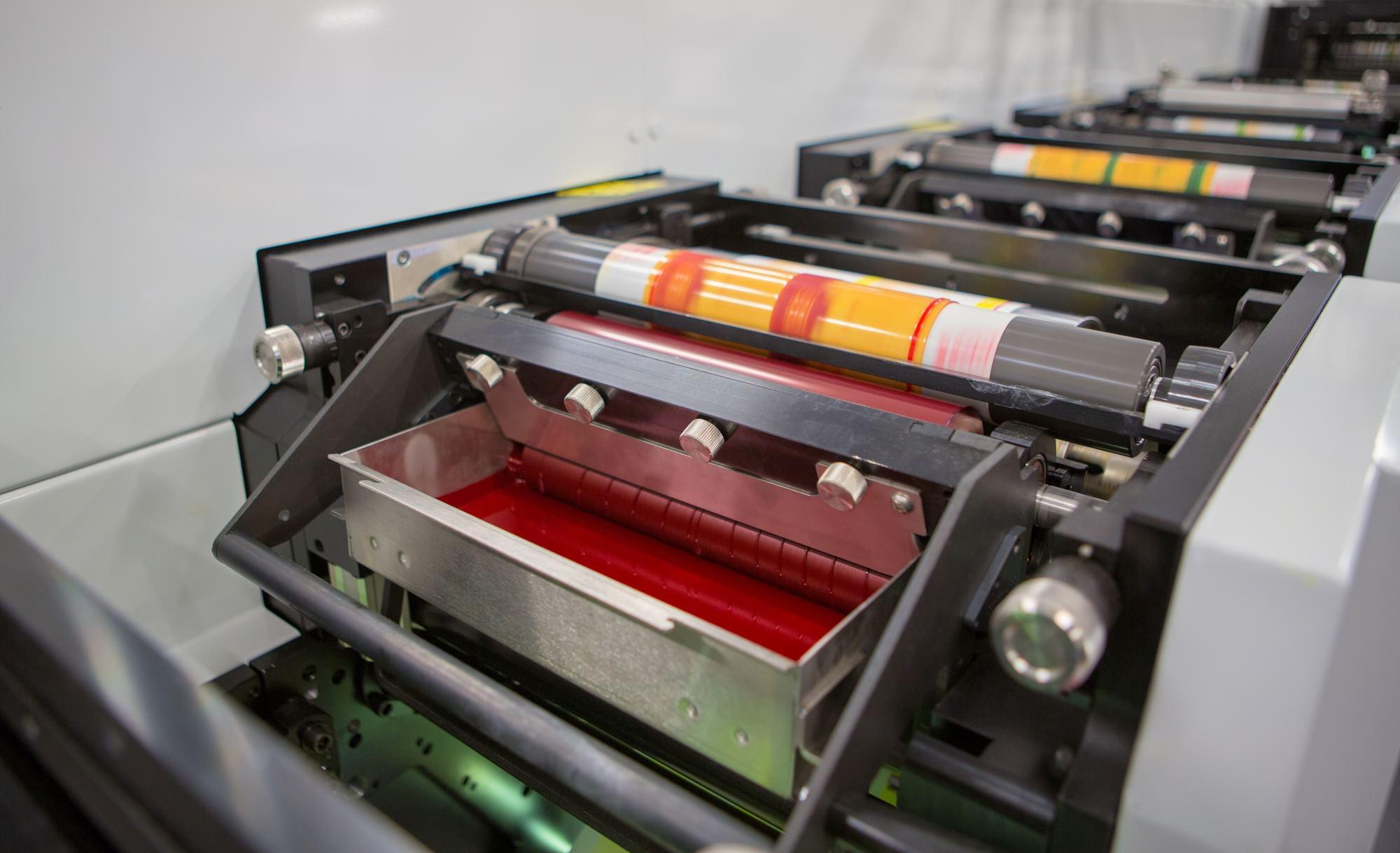
On the vapor side, look at ink pans, mixing and thinning, open containers, pumps, transfer points, spills, and press cleaning.
Ventilation also needs the right question. National Institute for Occupational Safety and Health (NIOSH) research shows that properly applied local exhaust ventilation can capture cleaning-solvent vapor near a press before it mixes with room air. That study addresses worker exposure control. It does not, by itself, certify fire or explosion protection for every press. A running fan is not performance evidence. Hood position, airflow, discharge location, makeup air, maintenance, and process changes all affect whether the system still performs its intended function.
Verify the Electrical Path for Each Transfer
OSHA requires precautions against ignition where flammable vapors may be present. For Category 1 or 2 flammable liquids, and Category 3 liquids with flash points below 100°F, OSHA also restricts use where open flames or other ignition sources lie within the possible path of vapor travel. A Category 3 liquid with a flash point at or above 100°F that is heated for use to within 30°F of its flash point must be handled under the requirements for a Category 3 liquid with a flash point below 100°F, so the same use restriction applies. The liquid category, operating temperature, and the operation determine applicability.
OSHA’s container-filling rule is similarly specific. When those same liquid categories, including a heated Category 3 liquid treated under the below-100°F requirements, are dispensed into containers, the nozzle and container must be electrically interconnected. That requirement should not be expanded into a claim that every container in every solvent task must always be bonded and grounded.
Bonding connects conductive objects to reduce the electrical potential difference between them. Grounding provides a conductive connection to earth where the system requires it. Neither control is proven by the presence of a clamp alone.
Paint, coatings, residue, liners, nonconductive containers, hoses, pumps, funnels, connection points, and equipment changes can affect the path. Follow the product information, equipment manufacturer’s instructions, applicable standards, and a qualified assessment. Do not improvise modifications or rely on a universal resistance limit, clamp location, or test frequency that has not been established for the system.
Electrical area classification is another site-specific decision. OSHA’s electrical standard applies where an area is classified because flammable vapors, liquids, gases, dusts, or fibers may be present in an ignitable concentration or quantity. Consider each room, section, or area individually. The presence of a solvent somewhere in the building does not automatically classify every nearby space, but equipment in a properly classified location must be suitable for that location.
Turn Winter Observations Into Verified Corrections
Use winter static as a prompt to check the complete ignition path:
- Confirm that the chemical inventory, labels, and current SDSs match the products at the press and in cleaning areas.
- Observe production and cleaning to identify where charge is generated, where vapor is released, and where the two could meet.
- Verify that ventilation and static-control equipment match the current process and are maintained as designed.
- Check applicable transfer setups for the required electrical interconnection, then document any qualified testing or correction.
- Make sure employees understand product hazards, what conditions to report, and whether their assigned role is evacuation, limited incipient-stage extinguisher use, or another site-specific response.
Emergency expectations need to match the facility’s written procedures and employee training. Providing an extinguisher does not mean every employee should fight a fire. OSHA distinguishes among workplaces that direct immediate evacuation, designate certain employees to use extinguishers, and make extinguishers available for employee use with required education and training.
Assign each finding to one owner and verify the correction in the operating area. A lower humidity reading or a noticeable shock can start the review. Base the conclusion on the products, vapor conditions, static-control path, ventilation, equipment suitability, procedures, and evidence.
GMG EnviroSafe can help assess EHS conditions, review Hazard Communication and fire-prevention practices, support employee training, and organize corrective actions within the scope of the engagement. When the review shows they are needed, appropriately qualified professionals should handle electrical classification, ventilation engineering, industrial hygiene testing, and equipment certification.
Contact GMG EnviroSafe to discuss the static and solvent-control questions in your printing operation.
Sources
(1) Canadian Centre for Occupational Health and Safety. Static Electricity. https://www.ccohs.ca/oshanswers/chemicals/static-electricity.html
(2) Electronic Code of Federal Regulations. 29 CFR 1910.106, Flammable Liquids. https://www.ecfr.gov/current/title-29/subtitle-B/chapter-XVII/part-1910/subpart-H/section-1910.106
(3) UK Health and Safety Executive. Fire and Explosion Risks in Printing. https://www.hse.gov.uk/printing/fire-explosion.htm
(4) National Institute for Occupational Safety and Health. Controlling Cleaning-Solvent Vapors at Small Printers, DHHS (NIOSH) Publication No. 98-107. https://www.cdc.gov/niosh/docs/hazardcontrol/hc24.html
(5) Occupational Safety and Health Administration. 29 CFR 1910.1200, Hazard Communication. https://www.osha.gov/laws-regs/regulations/standardnumber/1910/1910.1200
(6) Occupational Safety and Health Administration. Appendix D to 29 CFR 1910.1200, Safety Data Sheets. https://www.osha.gov/laws-regs/regulations/standardnumber/1910/1910.1200AppD
(7) Occupational Safety and Health Administration. 29 CFR 1910.307, Hazardous (Classified) Locations. https://www.osha.gov/laws-regs/regulations/standardnumber/1910/1910.307
(8) Occupational Safety and Health Administration. 29 CFR 1910.157, Portable Fire Extinguishers. https://www.osha.gov/laws-regs/regulations/standardnumber/1910/1910.157