Auto
Flammable Liquid Storage in Repair Shops: What to Check Beyond the Cabinet
A repair shop can have a labeled flammable-liquid cabinet, current chemical records, and a written procedure while weak controls continue on the floor. The breakdown may be a used solvent in the wrong container, excess inventory, or material left near heat or sparks after the job ends.
The cabinet is one stop in the product's path. Follow the liquid through storage, use, transfer, return, and, when applicable, waste.
Repair shops may combine mechanical service, collision repair, spray finishing, and fuel dispensing. Requirements may differ by area or task. Not every shop falls under the same rules.
OSHA's service station rules don't cover major repairs, body and fender work, or painting, so collision and repair shops often follow different requirements. Location matters too. Some states run their own safety programs, and state hazardous waste rules can be stricter than federal ones. Knowing which rules apply to your shop is the first step to staying compliant.
Identify the Product Before Deciding Where It Belongs
"Flammable" does not tell a shop enough to choose a container, cabinet, transfer method, or work location. Start with the product identifier, quantity, container, task, and current Safety Data Sheet (SDS).
Section 2 identifies hazards, Section 7 covers handling and storage, and Section 9 includes properties such as flash points. Flash point and boiling point help determine the OSHA category and the requirements that apply.
Compare the SDS with floor use:
- Is the correct product in the container?
- How much is present in the shop and at the workstation?
- Does the container fit the task and the liquid?
- Will the employee use it during the current work shift?
- Where does it go when the job stops or the shift ends?
Those answers establish whether the existing storage arrangement fits the material and the work.
Check the Cabinet and the Material Around It
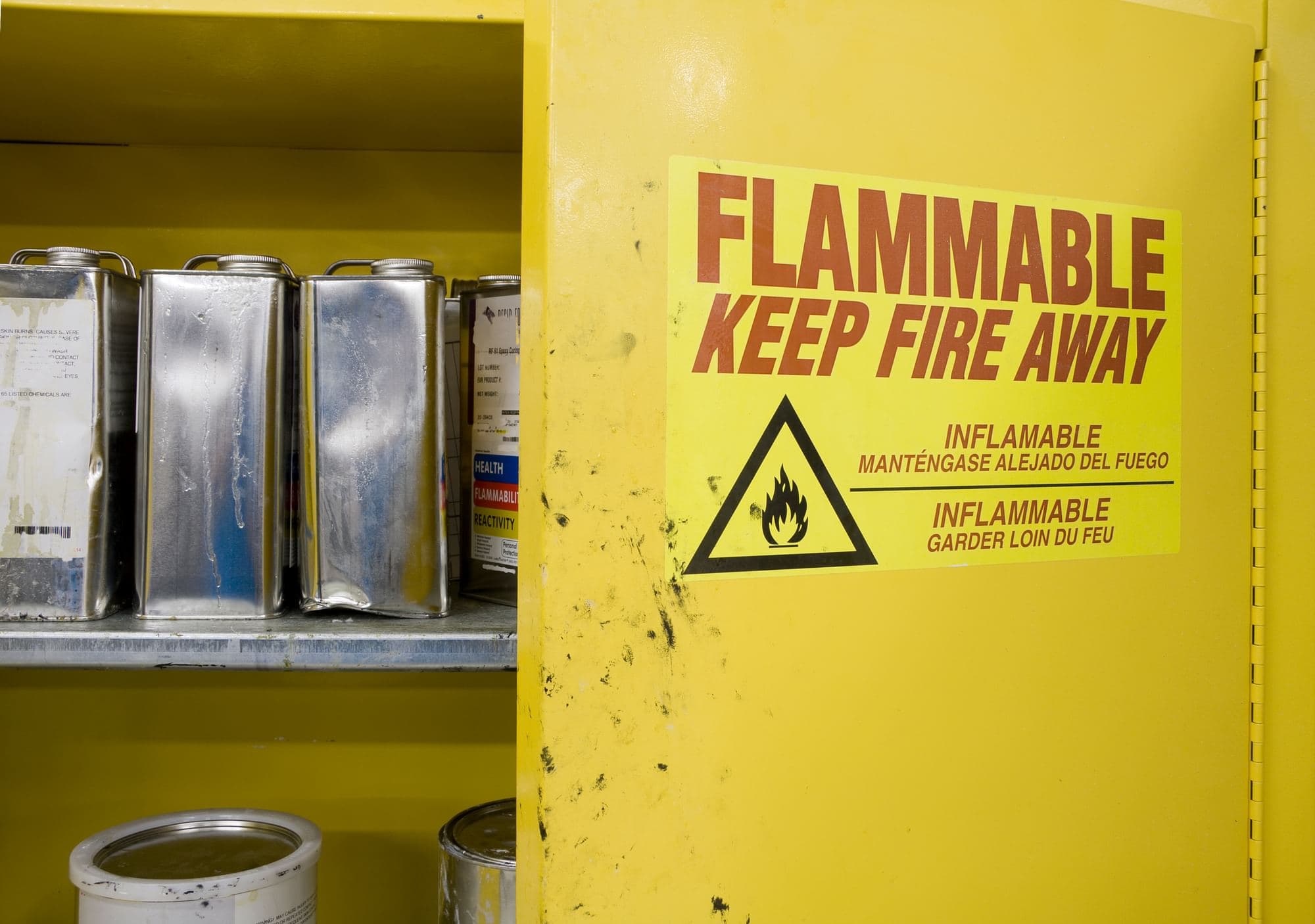
Under OSHA's general-industry flammable-liquids standard, a cabinet may hold no more than 60 gallons of Category 1, 2, or 3 flammable liquids or 120 gallons of Category 4 flammable liquids. The cabinet must meet applicable construction and fire-performance requirements and carry the required warning label.
A compliant cabinet does not correct damaged containers, incompatible materials, or excess product left elsewhere. Count what is inside, outside designated storage, and at points of use. An OSHA-approved State Plan may impose different requirements, so the federal cabinet limit is not the complete storage decision.
Walk the area during normal work. A temporary container may remain for days, or a product may return to the wrong place because designated storage is full.
Follow the Liquid When It Leaves Storage
These rules apply when flammable liquids support repair work rather than serve as the primary operation. Where OSHA's industrial-plant provisions cover incidental use, indoor transfer is limited to a closed piping system, a safety can, a device drawing through the top, or gravity through an approved self-closing valve. Air pressure cannot force liquid from a container or portable tank. The transfer area needs ventilation and a way to handle leaks or spills safely.
When the shop dispenses Category 1 or 2 liquids, or Category 3 liquids with a flash point below 100°F, OSHA requires electrical interconnection between the nozzle and receiving container. This connection helps prevent a static discharge from becoming an ignition source. The requirement applies only under those conditions.
The same industrial-plant provisions require specified lower-flash-point liquids to be covered when not actually in use, spill-control materials to be available, and ignition sources to remain outside the possible path of vapor travel. "Point of use" is not a general exemption.
Review the Ignition Environment With the Task
The risk follows vapor and spilled material beyond the cabinet. Welding and cutting, grinding, heaters, hot engines or exhaust components, electrical equipment, smoking, and transfer static can all matter. Vapor may also travel into low areas or pits before reaching an ignition source. OSHA's industrial-plant provisions require adequate precautions to prevent flammable vapors from igniting. The correct control depends on the liquid, amount, ventilation, equipment, and layout.
At the workstation, identify where the product is opened or poured, where vapor could move, and what energized or hot equipment operates nearby.
Keep the Container Connected to the Right Information
The Hazard Communication Standard requires workplace labels, a written program, employee information and training, and ready access to SDS during each work shift. Employees must be able to connect the container to the correct information.
OSHA's portable-container exception is narrow. A label is not required when the hazardous chemical is transferred from a labeled container for the immediate use of the employee who made the transfer. "Immediate use" means the chemical remains under that employee's control and is used only by that employee during the same work shift. Material left for another employee, another shift, or later use does not fit that exception. The exception concerns workplace labeling. It does not waive flammable-liquid storage, transfer, or ignition-control requirements.
On October 6, 2026, existing Hazard Communication duties remain in effect. For affected substances, employers must update workplace labels, the written program, and training as necessary by November 20, 2026.
The deadline for manufacturers, importers, and distributors to update substance labels and SDSs was May 19, 2026. For mixtures, the employer deadline is May 19, 2028. The applicable date depends on the chemical and the employer's role.
Give Waste Its Own Management Path
Once material is discarded, it is no longer only a product-storage question. At the point of generation, the shop must determine whether each solid waste is hazardous. If it is, the waste type and monthly amount determine the federal generator category and affect how the shop must manage it. State categories may differ.
Qualifying solvent-contaminated wipes may follow a special path. The United States Environmental Protection Agency (EPA) conditionally excludes certain wipes sent for cleaning or disposal, but only when the shop meets the applicable conditions. These include closed, non-leaking containers, the label "Excluded Solvent-Contaminated Wipes," a 180-day accumulation limit, records, and no free liquids at shipment. The exclusions do not cover every contaminated rag and apply only where the state has adopted them, or EPA administers the program.
Used solvent, used oil, liquid waste, absorbents, and wipes each need an identified management path.
Close the Loop Where the Condition Was Found
Every mismatch needs an owner, corrective action, and verification date. An unlabeled portable container may require more than a label. Determine who transferred it, whether immediate use applies, where it belongs after the task, and whether the practice will recreate the condition.
Record the condition, applicable requirement, owner, target date, and completed action. Return during normal work to verify that the controls now match the task.
When a shop cannot trace those decisions from inventory through disposal, a site-specific assessment can identify where written procedures and floor practice have separated.
Contact GMG EnviroSafe to schedule a flammable-liquid storage and handling assessment for your facility. We'd be glad to review your chemical inventory, point-of-use practices, Hazard Communication documentation, employee training, and corrective-action follow-through.
Sources
(1) Electronic Code of Federal Regulations, 29 CFR 1910.106, Flammable Liquids. https://www.ecfr.gov/current/title-29/section-1910.106
(2) Occupational Safety and Health Administration, State Plans Frequently Asked Questions. https://www.osha.gov/stateplans/faqs
(3) United States Environmental Protection Agency, State Authorization Under the Resource Conservation and Recovery Act (RCRA). https://www.epa.gov/rcra/state-authorization-under-resource-conservation-and-recovery-act-rcra
(4) Electronic Code of Federal Regulations, 29 CFR 1910.1200, Hazard Communication. https://www.ecfr.gov/current/title-29/section-1910.1200
(5) Occupational Safety and Health Administration, HCS 2024 Compliance Date Extension Notice. https://www.osha.gov/hazcom/rulemaking/extension
(6) Electronic Code of Federal Regulations, 40 CFR 262.11, Hazardous Waste Determination and Recordkeeping. https://www.ecfr.gov/current/title-40/section-262.11
(7) Electronic Code of Federal Regulations, 40 CFR 262.13, Generator Category Determination. https://www.ecfr.gov/current/title-40/section-262.13
(8) United States Environmental Protection Agency, Categories of Hazardous Waste Generators. https://www.epa.gov/hwgenerators/categories-hazardous-waste-generators
(9) Electronic Code of Federal Regulations, 40 CFR 261.4, Exclusions. https://www.ecfr.gov/current/title-40/section-261.4
(10) United States Environmental Protection Agency, Frequent Questions About Implementing the Regulations for Solvent-Contaminated Wipes. https://www.epa.gov/hwgenerators/frequent-questions-about-implementing-regulations-solvent-contaminated-wipes
(11) United States Environmental Protection Agency, Where Is the Solvent-Contaminated Wipes Final Rule in Effect? https://www.epa.gov/hwgenerators/where-solvent-contaminated-wipes-final-rule-effect