Auto
Lockout/Tagout for Car Wash Equipment: Stopping the Unexpected Startup
Car wash equipment is built to run automatically, at speed, and for long hours, which is exactly what makes servicing it hazardous. A conveyor, brush, or pump that appears to be stopped can still restart, move, release pressure, or expose an employee to stored energy if it has not been properly isolated. Most incidents happen not while equipment is running, but while someone is clearing a jam, freeing a roller, or making an adjustment on a machine that only looks shut off.
In a car wash, "off" and "safe" are not the same thing. Lockout/tagout closes that gap by giving employees a clear process to shut equipment down, isolate hazardous energy, verify that it is controlled, and return the equipment to service safely. This guide covers what the standard requires, where car wash operators most often misjudge the risk, and how to build the practice into everyday service.
What "Unexpected Startup" Really Means
Lockout/tagout (LOTO) exists to control one specific risk: not the machine that is obviously running, but the one that only appears to be stopped. It's the practice of isolating a machine's energy sources during service so it can't restart or release stored energy while someone is working on it. OSHA sets the rules in its Control of Hazardous Energy standard, 29 CFR 1910.147, which covers any servicing or maintenance where unexpected energization, startup, or stored-energy release could injure a worker. (1)
The stakes are real. OSHA has long estimated that compliance with the standard prevents roughly 120 deaths and 50,000 injuries each year. (2) Lockout/tagout also remains a major OSHA focus area, consistently ranking among the most-cited standards in recent years. (3)
Car washes are squarely in that picture. In 2023, OSHA cited a national car wash brand over $250,000 for lockout/tagout and electrical violations. In cases like this, inspectors often find workers servicing the tunnel without lockout protection around automatically controlled equipment, high-pressure water, and heated blowers, and lockout/tagout kits still sitting in their boxes. The equipment to comply is on-site, and the program exists on paper. What's missing is practice.
The Hazardous Energy Hiding in a Car Wash Tunnel
Cutting power at a single breaker is not sufficient, because a car wash holds several kinds of energy at once, and the standard names most of them: electrical, mechanical, hydraulic, pneumatic, chemical, and thermal. (1) In a tunnel, these sources are present throughout:
- Electrical: motors driving the conveyor, brushes, and wheel spinners; banks of high-horsepower blower motors; pump and control-panel power. Capacitors can hold a charge even after the power is off.
- Mechanical and stored motion: the conveyor chain and rollers, spinning top, side, and rocker brushes, mitters, and the tension held in a stretched chain.
- Hydraulic: many conveyors and correlators run on hydraulic drives, and cylinders can hold pressure long after the pump stops.
- Pneumatic: air take-up cylinders, compressors, and receiver tanks stay pressurized after shutdown; that stored air is classic hazardous energy.
- Chemical and pressure-related hazards: presoak, foam, and tire-shine lines may stay pressurized, so a line opened during service can release concentrated cleaning chemicals.
- Thermal: heated blowers and hot-water systems stay hot after they stop.
There's a second trap unique to systems like a wash tunnel: interconnected equipment. Locking out the brush motor being serviced may still leave a worker exposed to the conveyor, a nearby pump, or a high-pressure line that has its own separate isolation point and can move, spray, or energize during the task. (4) For car wash conveyor safety, the procedure has to account for the equipment around the task, not just the single component being serviced.
OSHA's own overview describes the core scenario directly: a jammed conveyor suddenly releases and injures the worker who was trying to clear it. (2)
Why the Stop Button Isn't Lockout
The single most common and most dangerous misunderstanding in car wash operations is this: hitting the stop button, pausing the controller, or pressing the emergency stop is not lockout.
Under the standard, push buttons, selector switches, and e-stops are control devices, not energy-isolating devices. (1) They tell the machine to stop; they do not disconnect it from its energy. Isolation means operating the actual energy-isolating device, the circuit breaker, the disconnect switch, or the line valve, and physically locking it in the off position so it cannot be turned back on until the person doing the work removes their own lock and/or tag.
An e-stop is an emergency control. A stop button is an operating control. Lockout is energy control. They are not interchangeable, and treating the first two as if they were the third is exactly how a "stopped" machine begins moving while someone is servicing it.
This is also why verification is a required step, not a formality. A worker can open the breaker, assume the machine is de-energized, and still be wrong: a capacitor discharges, backup power engages, or hydraulic pressure drifts a cylinder. Before any work begins on the equipment, an authorized employee must confirm zero energy by testing the start controls, checking pressure gauges, or metering for voltage. (1)
The "Quick Jam Clear" and OSHA's Minor Servicing Exception
Most car wash injuries do not happen during scheduled repairs. They happen during the brief, routine task that no one treats as servicing: clearing a jam, freeing a roller, removing debris from a brush, repositioning a stuck vehicle. Operators often assume these fall under OSHA's minor servicing exception, which allows certain tasks during normal production to proceed without full lockout. That assumption is a frequent cause of serious injury.
The exception is narrow. It applies only when the task is routine, repetitive, and integral to production, and only when the employer has put alternative measures in place that provide effective protection. (1) Tasks that require bypassing or removing a guard, or reaching into an area where unexpected movement could injure someone, generally fall outside routine minor servicing unless effective alternative protection is already in place. (5) For a car wash, that means clearing jams, reaching into conveyor paths, or working near brush, roller, or chain-and-sprocket pinch points should be reviewed carefully before anyone assumes the task is "minor."
"Alternative measures" here means genuine engineering protection, an interlocked barrier guard, a specially designed reach tool, or a local disconnect under the sole control of the person performing the work, not simply pressing the stop button while the drive can still cycle. When there's doubt about whether a task qualifies, the safer course is to evaluate it carefully and lock out if the exposure can't be controlled another way.
What a Proper Lockout Procedure Looks Like
A compliant lockout is a sequence, and every step matters:
- Identify every energy source for the specific machine, and tell affected employees the equipment is going down.
- Shut down using normal stopping procedures, in an orderly way.
- Isolate each energy source at its energy-isolating device, the breaker, disconnect, or valve, not the control panel.
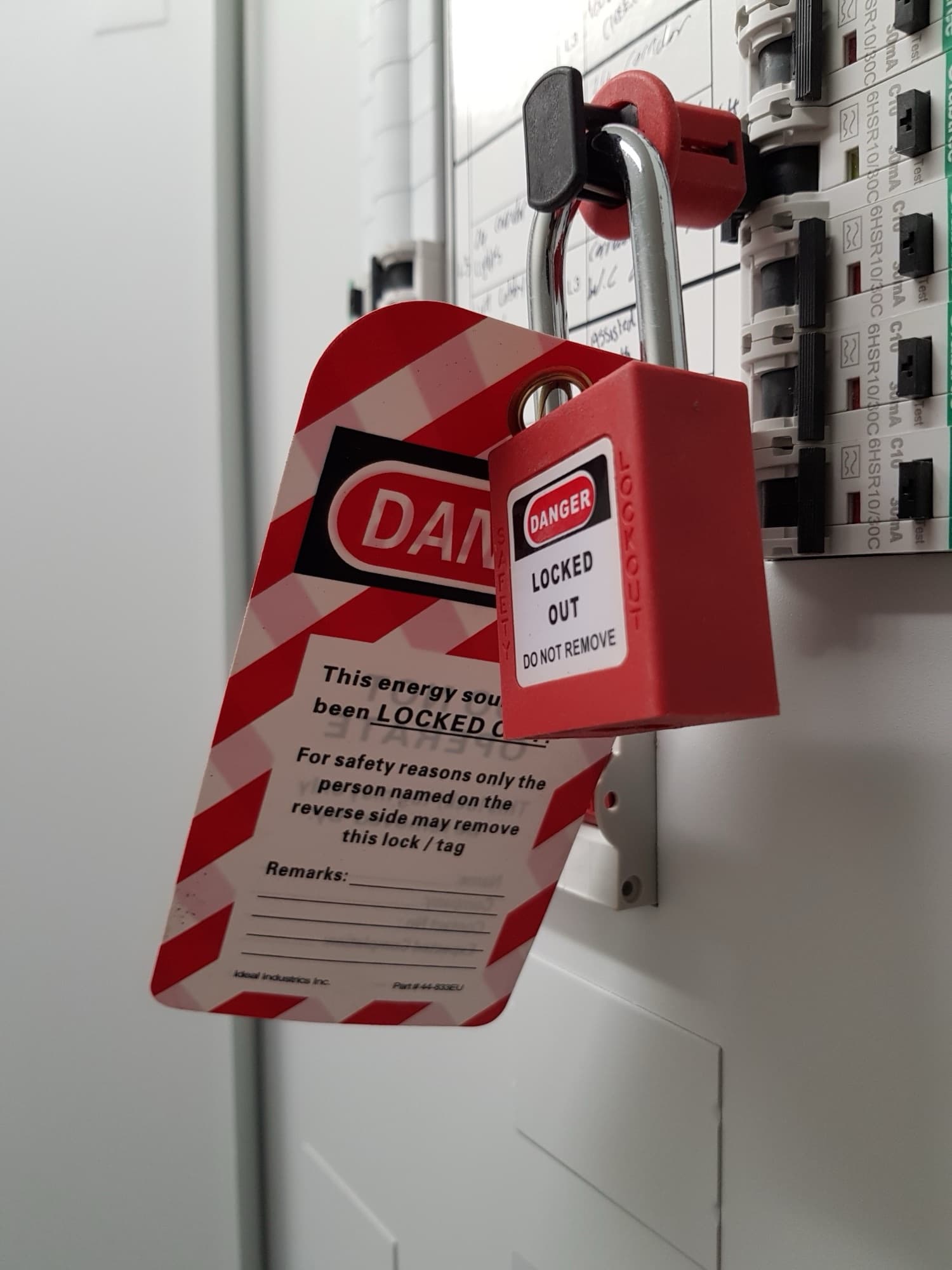
- Apply locks and/or tags to each isolating device. Each authorized employee applies their own personal lock and/or tag; the tag names who, when, and why.
- Release or restrain stored energy: bleed hydraulic pressure, vent compressed air, relieve chain tension, block raised components, discharge capacitors, and let heated parts cool.
- Verify zero energy before touching anything, by testing that the machine cannot start and confirming it is de-energized.
- Return to service in a controlled way: clear tools and people, reinstall guards, confirm the tunnel is clear, and notify affected employees before anyone restores power. Each worker removes only their own lock and/or tag. (1)
Lockout is the default, not one option among equals. Tagout alone is limited and must meet OSHA's specific requirements: where an energy-isolating device is capable of being locked out, lockout is the expected method unless the employer can demonstrate that a tagout system provides equivalent protection. (1)
Building an Energy Control Program, Not Just a Kit
Owning lockout hardware is not the same as running a lockout program. A compliant program has parts that a kit on the wall cannot supply: (1)
- A written energy control program covering which equipment is included, who is authorized, and how the whole system works.
- Written procedures matched to your specific wash system. A generic, one-size-fits-all procedure is a common weak spot, because it may not account for your system's energy sources, isolation points, stored-energy steps, and verification method. Build the procedure around your specific wash system, reflecting the actual conveyors, pumps, blowers, and chemical systems on-site.
- Training by role. Authorized employees (who lock and/or tag out and service) need the deepest training; affected employees (attendants, cashiers, anyone who runs or works near the equipment) need to understand the procedure and never touch a machine that's locked out and/or tagged out; other employees in the area need the basic prohibition against restarting anything under a lock and/or tag. Retraining follows any change in equipment, task, or procedure.
- An annual periodic inspection of each procedure, performed by an authorized employee who is not the one using that procedure, to catch drift between what's written and what the tunnel actually looks like now.
Two further points apply specifically to a car wash. When several technicians, or an outside equipment vendor, work on the same system, each applies their own lock and/or tag, and on a shift change the incoming lock and/or tag is applied before the outgoing one is removed, so protection never lapses. Because vendors service tunnels regularly, the site and the contractor should exchange procedures and agree on who controls startup, rather than either side assuming the other has managed it.
Common Car Wash LOTO Gaps to Check
Most programs don't fail all at once; they slip in small, recognizable ways. A quick self-check for any wash:
- Lockout/tagout kits are on-site but rarely used
- Procedures are generic rather than specific to your wash system
- Employees rely on the e-stop or a controller pause instead of isolating energy
- The conveyor is stopped but not locked out and/or tagged out at the disconnect
- High-pressure water, air, or hydraulic lines aren't depressurized before service
- Brushes, rollers, or nearby equipment stay energized while a task is underway
- Managers or attendants clear jams without following the lockout procedure
- Contractors service tunnel equipment without a shared procedure
- The annual periodic inspection gets skipped
- Guards come off for service and aren't reinstalled before startup
- Affected employees aren't told when equipment is locked out and/or tagged out, or returned to service
If several of these look familiar, it may be time to review the program before the next service task and confirm that the written procedure matches how the work is actually being done.
Before the Next Jam
Many serious lockout incidents follow the same pattern: equipment that appeared stopped, a task that felt routine, and hazardous energy that hadn't been fully controlled. A car wash runs on speed and automation, which is exactly why the discipline of shutting down, isolating, releasing stored energy, and verifying zero energy must be built into how a team services the tunnel, rather than improvised under production pressure.
Effective car wash OSHA compliance is built around your specific wash system. That's the work GMG EnviroSafe does with car wash operators: identifying the energy sources on your actual equipment, writing a procedure that accounts for the specific conveyors, pumps, blowers, and chemical systems in your wash, training your people by role, and running the annual periodic inspection that keeps the program honest. The goal isn't a binder on a shelf or a kit still in its box. It's a car wash operation where "off" and "safe" are clearly defined, understood, and followed.
If your team services, cleans, clears, or maintains tunnel or bay equipment, GMG EnviroSafe can help you build lockout/tagout procedures and training that match the equipment on-site and the way your team actually works.
Sources
- OSHA. The Control of Hazardous Energy (Lockout/Tagout), 29 CFR 1910.147. osha.gov/laws-regs/regulations/standardnumber/1910/1910.147
- OSHA. Control of Hazardous Energy (Lockout/Tagout) Overview and Fact Sheet. osha.gov/control-hazardous-energy
- OSHA. Top 10 Most Frequently Cited Standards. osha.gov/top10citedstandards
- OSHA. Lockout/Tagout eTool. osha.gov/etools/lockout-tagout
- OSHA. Lockout/Tagout eTool: Minor Servicing Exception. osha.gov/etools/lockout-tagout/hot-topics/relationship-subpart-o/minor-servicing-exception