Construction
Construction Site Fire Prevention: Build the Program Before Work Starts
A construction site can change its fire load before the first shift ends. Temporary power comes online, packaging and lumber accumulate, hot work moves near new fuel sources, and access routes become shared with deliveries and equipment. The fire-prevention approach has to change with the job, not remain frozen at mobilization.
Federal OSHA requires employers to develop and maintain an effective fire protection and prevention program at the job site throughout all phases of construction and demolition work, and to make the fire protection and suppression equipment required by the construction standard available, with no delay in providing necessary equipment as fire hazards occur. That is a federal baseline. The protection plan needs to reflect the actual work, materials, access, and emergency arrangements at the site.
Build the Framework Before Mobilization
Before work begins, identify who will coordinate fire protection as conditions change, how contractors will communicate high-risk work, where emergency access and assembly areas will be, where the plan will be documented, and how site changes are continually reviewed. OSHA assigns the employer responsibility for fire protection throughout construction and requires the employer to develop a fire protection program for all phases of work.
On a multi-employer project, each employer remains responsible for protecting its own employees, while the controlling employer may have duties to exercise reasonable care to prevent or detect violations throughout the project. That makes contractor coordination operational, not administrative. A change in staging, sequencing, temporary utilities, or access can alter others' fire exposure.
Track Ignition Sources and Fuel Together
Daily site assessment should consider ignition sources, combustible material loading, and the controls separating them. Hot work, temporary electrical equipment, smoking, powered equipment, and temporary heaters each need attention when combustible materials are nearby. OSHA's construction fire-prevention standard addresses these conditions, including ignition hazards and the storage of combustible materials.
Keep Extinguishers Matched to the Work
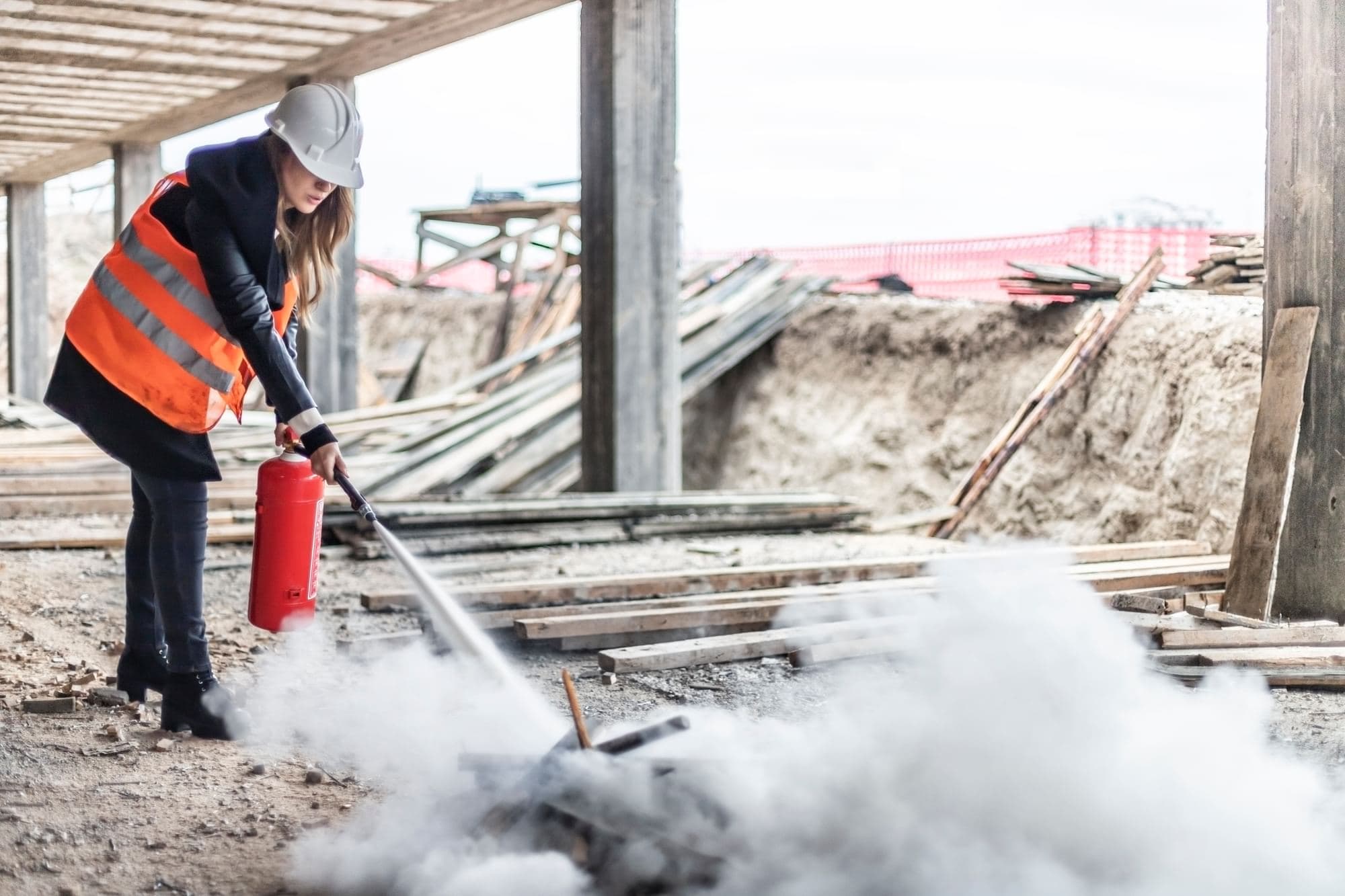
Extinguishers must be conspicuously located, periodically inspected, maintained in operating condition, and replaced immediately if defective. For protected building areas, OSHA establishes a baseline of at least one extinguisher rated not less than 2A for each 3,000 square feet of protected building area, or major fraction of it, with travel distance from any point to the nearest extinguisher not exceeding 100 feet. One or more 2A-rated extinguishers must be provided on each floor, and in multistory buildings at least one must be located adjacent to a stairway.
Where more than five gallons of flammable or combustible liquid or more than five pounds of flammable gas are being used, OSHA requires at least one 10B-rated extinguisher within 50 feet. The requirement does not apply to the integral fuel tanks of motor vehicles. Those are baseline requirements. A field check should also confirm clear access and whether the equipment still fits the day's work.
Control Hot Work, Liquids, LP-Gas, and Temporary Heat
Hot work requires coordination before striking a spark. OSHA's construction standard requires that, when practical, the object to be welded, cut, or heated be moved to a designated safe location. If it cannot be readily moved, all movable fire hazards in the vicinity must be taken to a safe place or otherwise protected, and where the fire hazards cannot be removed, positive means must be taken to confine heat, sparks, and slag and to protect the immovable hazards from them. Suitable fire extinguishing equipment must be immediately available in the work area. A fire watch is required in the situations specified by the standard, including when normal fire-prevention precautions are not sufficient. Do not present a universal fire-watch duration or permit rule when the applicable requirement depends on the work and jurisdiction.
Flammable-liquid storage and handling, LP-Gas systems, and temporary heating each have their own construction requirements. The practical control is to confirm that materials, containers, temporary heat, and equipment locations are reviewed as site conditions change, especially when colder-weather work begins.
Use Housekeeping, Egress, and Water Supply as Fire Controls
OSHA requires debris to be kept clear from work areas, passageways, and stairs, and requires open yard storage areas to be kept free of unnecessary combustible materials. Exits and means of egress must remain free and unobstructed. On an active site, this means assigning ownership for cleanup, staging, and route checks rather than waiting for a walk-through to expose the problem.
Temporary offices, sheds, storage containers, and material laydown areas deserve the same review. Their location can affect egress, combustible material loading, equipment access, and responder access. Treat placement as part of the fire-prevention program, not only as a logistics decision. If a delivery or trade change blocks a path, identify an interim control and an owner before the condition becomes routine.
Fire protection is also more than portable extinguishers. The construction standard addresses water supply, standpipes, and fire-protection systems as building conditions change. Review those protections against the project schedule so a changed building condition doesn't leave the site relying on a control that no longer fits.
A safety walk or assessment can make this coordination visible. Compare the written arrangements with what crews can actually reach: extinguishers, exit paths, alarm instructions, water sources, and emergency access. Record the condition, corrective action, owner, and follow-up. This is not a substitute for a site-specific hazard assessment, but it helps surface field changes early enough to manage before they become a larger issue.
Confirm the Response and the Local Requirements
OSHA requires an alarm system so employees and the local fire department can be alerted in an emergency, with the alarm code and reporting instructions conspicuously posted at phones and at employee entrances. A short pre-task review can confirm the reporting method, site address, assembly point, responder access, and high-risk work planned for the shift.
Federal OSHA is not the only authority. The fire code adopted by the state or local jurisdiction may add project-specific requirements for site safety plans, fire watches, hot-work permits, water supply, responder access, or temporary protection systems. Confirm those requirements with the authority having jurisdiction.
A site-specific review should also account for owner requirements, permits, and emergency-response arrangements that may be more restrictive than the federal or state baseline. Do not assume a model-code provision or a practice from another project automatically applies. Confirm the applicable requirement before relying on it in practice.
Contact GMG EnviroSafe to discuss an on-site EHS compliance assessment for your construction operation. GMG can help review site conditions, identify compliance gaps, organize corrective actions, and support the documentation your team needs to manage changing work.
Sources
(1) Electronic Code of Federal Regulations. 29 CFR 1926.24, Fire Protection and Prevention. https://www.ecfr.gov/current/title-29/section-1926.24
(2) Occupational Safety and Health Administration. Multi-Employer Citation Policy, CPL 02-00-124. https://www.osha.gov/enforcement/directives/cpl-02-00-124
(3) Electronic Code of Federal Regulations. 29 CFR 1926.151, Fire Prevention. https://www.ecfr.gov/current/title-29/section-1926.151
(4) Electronic Code of Federal Regulations. 29 CFR 1926.150, Fire Protection. https://www.ecfr.gov/current/title-29/section-1926.150
(5) Electronic Code of Federal Regulations. 29 CFR 1926.352, Fire Prevention (Welding, Cutting, and Heating). https://www.ecfr.gov/current/title-29/section-1926.352
(6) Electronic Code of Federal Regulations. 29 CFR 1926.152, Flammable Liquids. https://www.ecfr.gov/current/title-29/section-1926.152
(7) Electronic Code of Federal Regulations. 29 CFR 1926.153, Liquefied Petroleum Gas (LP-Gas). https://www.ecfr.gov/current/title-29/section-1926.153
(8) Electronic Code of Federal Regulations. 29 CFR 1926.154, Temporary Heating Devices. https://www.ecfr.gov/current/title-29/section-1926.154
(9) Electronic Code of Federal Regulations. 29 CFR 1926.25, Housekeeping. https://www.ecfr.gov/current/title-29/section-1926.25
(10) Electronic Code of Federal Regulations. 29 CFR 1926.34, Means of Egress. https://www.ecfr.gov/current/title-29/section-1926.34