Construction
Construction Noise and Hearing Loss: What Contractors Need to Measure, Control, and Document
Construction noise is not a fixed condition. A saw moves indoors, another trade starts work nearby, a compressor runs longer than planned, or a crew changes its sequence. Those changes can alter an employee's exposure and can mask alarms, verbal warnings, and changes in equipment sound. Occupational noise can cause permanent hearing damage, so noise reduction, proper planning, effective hearing protection, and reliable communication methods belong in the same field-level discussion.
Start With the Exposure Evaluation, Not the PPE Box
A box of earplugs does not establish that exposure has been evaluated or controlled. Observe the work while it is performed and document the task, equipment, location, duration, nearby trades, and conditions that may affect exposure. Area sound measurements can help characterize a location. Personal noise dosimetry is often the better tool for understanding an employee's combined exposure across a shift or variable tasks or processes that one or more employees perform. Several instruments are commercially available to assess workplace noise levels, but they must meet reliability, calibration, and quality control standards; using a cell phone decibel meter app does not replace employee noise exposure monitoring.
Federal OSHA's construction noise standard uses Table D-2. It permits an 8-hour exposure of 90 dBA and reduces the allowable duration as sound levels rise, using a 5 dB exchange relationship. The standard also limits exposure to impulse or impact noise at 140 dB peak sound pressure level. When employee exposures exceed the Table D-2 limits, employers must use feasible administrative or engineering controls to limit employee exposures. Effective hearing protection is required where those controls do not reduce exposure to permissible levels.
A Construction Hearing Conservation Program Has a Specific Trigger
Federal construction differs from OSHA's general-industry 85 dBA action level. OSHA's construction guidance states that a continuing, effective hearing conservation program is required when employee exposures exceed the levels in Table D-2, including 90 dBA over 8 hours. OSHA has interpreted an effective construction program to include monitoring, engineering controls, administrative controls, individually fitted hearing protection, training, baseline and annual audiometry, follow-up, and recordkeeping. The details of an effective construction hearing conservation program should apply to the work performed and realistic job site conditions, not be copied wholesale from the general industry regulations.
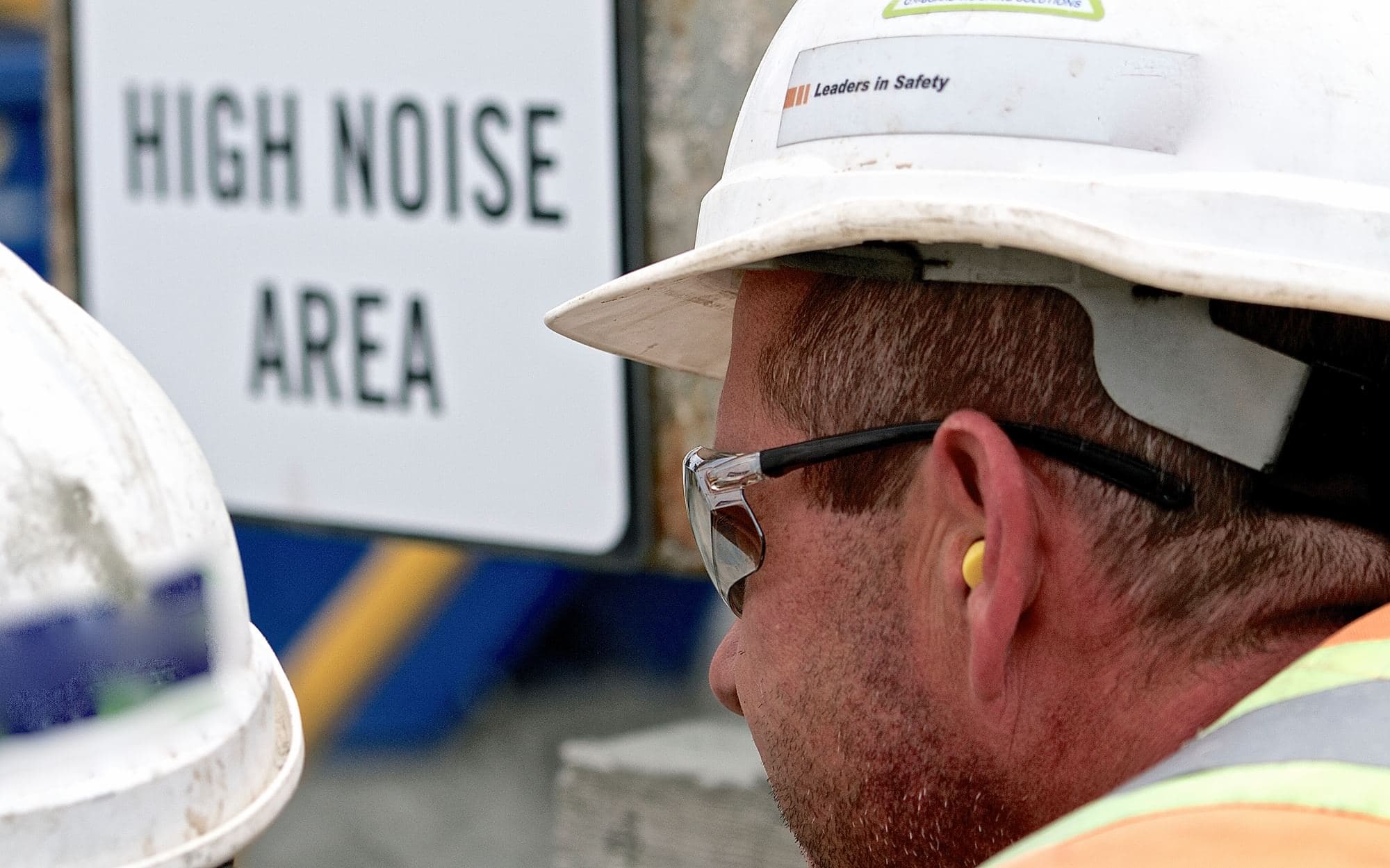
Hearing protection must fit each affected employee properly. For protectors inserted in the ear, 29 CFR 1926.101 requires that they be fitted or determined individually by competent persons. The employer must provide required PPE at no cost to employees, subject to the limited exceptions in 29 CFR 1926.95. Evaluate attenuation against the employee's actual exposure rather than assuming it from the package Noise Reduction Rating alone. Individual fit testing is an industry-leading practice, but it is not a federal mandate.
Training, Testing, and Follow-Up Belong in the Field Process
Training must give employees a usable understanding of the noise hazards in their work, the controls in place, the protection selected, and the limits of that protection. A toolbox talk may support that effort, but it is not the entire hearing conservation and training process. Supervisors should be able to recognize when a change in task, location, equipment, or schedule calls for re-evaluating exposures. OSHA's construction training rule also requires employers to teach employees to recognize and avoid unsafe conditions in their work environment. A strong training program helps employees at all levels know when to STOP and re-evaluate conditions.
Audiometric testing and follow-up are part of OSHA's interpretation of a continuing, effective construction hearing conservation program. They should be managed through a qualified occupational-health process, with appropriate confidentiality and communication to the employee. Do not assume that every general-industry testing deadline or retention practice applies unchanged to federal construction. The practical management question is whether the employer can show that the required program elements are functioning, that changes are investigated, and that corrective action follows when the evidence identifies a problem.
Reduce Noise Through Work Design
Hearing protection is not a substitute for reducing noise where feasible. A jobsite review may identify quieter equipment choices, maintenance needs, barriers or enclosures, separation of noisy work, different sequencing, or time limits in a high-noise area. Administrative controls must reduce exposure, not simply transfer the same exposure to another crew.
Pre-task planning is a practical way to identify changing noise conditions, but it does not replace exposure assessment or controls. Ask what equipment will operate, who will be nearby, how warnings will be communicated, and whether multiple tasks will combine over the shift. Consumer music or noise-canceling headphones are not automatically acceptable hearing protection. Workers should not remove required protection simply to communicate. Instead, plan reliable signals, visual warnings, radios or other methods appropriate to the work and protection selected.
Coordinate Across Trades and Keep the Evidence
Noise generated by one trade can expose another. On multi-employer sites, each employer should clarify its own responsibilities and coordinate work that affects adjacent crews. A general contractor does not automatically own every subcontractor's hearing-conservation duties, but shared conditions should not be left unaddressed. OSHA's multi-employer citation policy evaluates creating, exposing, correcting, and controlling roles based on the facts.
Keep monitoring results with operating conditions, equipment, duration, nearby work, and calibration information. Maintain required audiometric and program records, and distinguish those from useful management documentation. OSHA recordkeeping has separate hearing-loss criteria under 29 CFR 1904.10; recordability depends on the regulation's thresholds and work-relatedness test, not merely a report of hearing difficulty.
GMG EnviroSafe can provide a Workplace Noise Exposure Assessment to help you identify and document workplace noise conditions and provide practical recommendations to help protect employees' hearing. The findings can support better decisions about engineering and administrative controls, work practices, hearing protection, and follow-through.
Sources
(1) National Institute for Occupational Safety and Health. Occupational Noise Exposure. https://www.cdc.gov/niosh/noise/about/index.html
(2) Occupational Safety and Health Administration. Occupational Noise Exposure: Construction. https://www.osha.gov/noise/construction
(3) Occupational Safety and Health Administration. 29 CFR 1926.52, Occupational Noise Exposure. https://www.osha.gov/laws-regs/regulations/standardnumber/1926/1926.52
(4) Occupational Safety and Health Administration. 29 CFR 1926.101, Hearing Protection. https://www.osha.gov/laws-regs/regulations/standardnumber/1926/1926.101
(5) Occupational Safety and Health Administration. 29 CFR 1926.95, Criteria for Personal Protective Equipment. https://www.osha.gov/laws-regs/regulations/standardnumber/1926/1926.95
(6) Occupational Safety and Health Administration. CPL 02-00-124, Multi-Employer Citation Policy. https://www.osha.gov/enforcement/directives/cpl-02-00-124
(7) Occupational Safety and Health Administration. 29 CFR 1904.10, Recording Criteria for Cases Involving Occupational Hearing Loss. https://www.osha.gov/laws-regs/regulations/standardnumber/1904/1904.10
(8) Occupational Safety and Health Administration. State Plans. https://www.osha.gov/stateplans
(9) Occupational Safety and Health Administration. 29 CFR 1926.21, Safety Training and Education. https://www.osha.gov/laws-regs/regulations/standardnumber/1926/1926.21
(10) Occupational Safety and Health Administration. Standard Interpretation, Effective Hearing Conservation Program Elements for the Construction Industry (August 4, 1992). https://www.osha.gov/laws-regs/standardinterpretations/1992-08-04