General
OSHA Fire Safety Requirements That Slip Between Inspections
An up-to-date extinguisher tag can create false confidence. It says one piece of fire safety received attention. It does not tell you whether an exit is blocked, an emergency role changed with the shift, an alarm can be recognized across the facility, or a corrective action was ever closed.
That distinction is timely as Fire Prevention Week approaches on October 4 through October 10, 2026. The campaign is a useful reminder, but it does not create OSHA duties by itself. Workplace fire safety comes from the requirements that apply to the facility, the conditions on the floor, and the way employers keep plans, equipment, people, and records aligned.
Fire Safety Is a Connected Operating System
Federal OSHA addresses workplace fire safety across several standards, not through one annual checklist. Exit routes, emergency action plans, fire prevention plans, portable extinguishers, employee alarms, and hazard-specific rules each cover a different part of the system.
The overlooked gap is often the connection between them. A plan may direct employees to evacuate, while day-to-day practice leaves them unsure whether they should use an extinguisher. A posted route may no longer match the path around stored materials. An alarm may work during a test but still be difficult to perceive in a loud or isolated work area.
A useful review starts with one question: would the current system work during today's shift, with today's layout, staffing, equipment, and hazards?
Exit Routes Fail Through Everyday Drift
Workplaces generally need at least two exit routes located as far apart as practical. One may be permitted when the workplace size, occupancy, employee count, or arrangement allows safe evacuation, and more than two may be required when two would not be enough. The correct number depends on the facts of the facility.
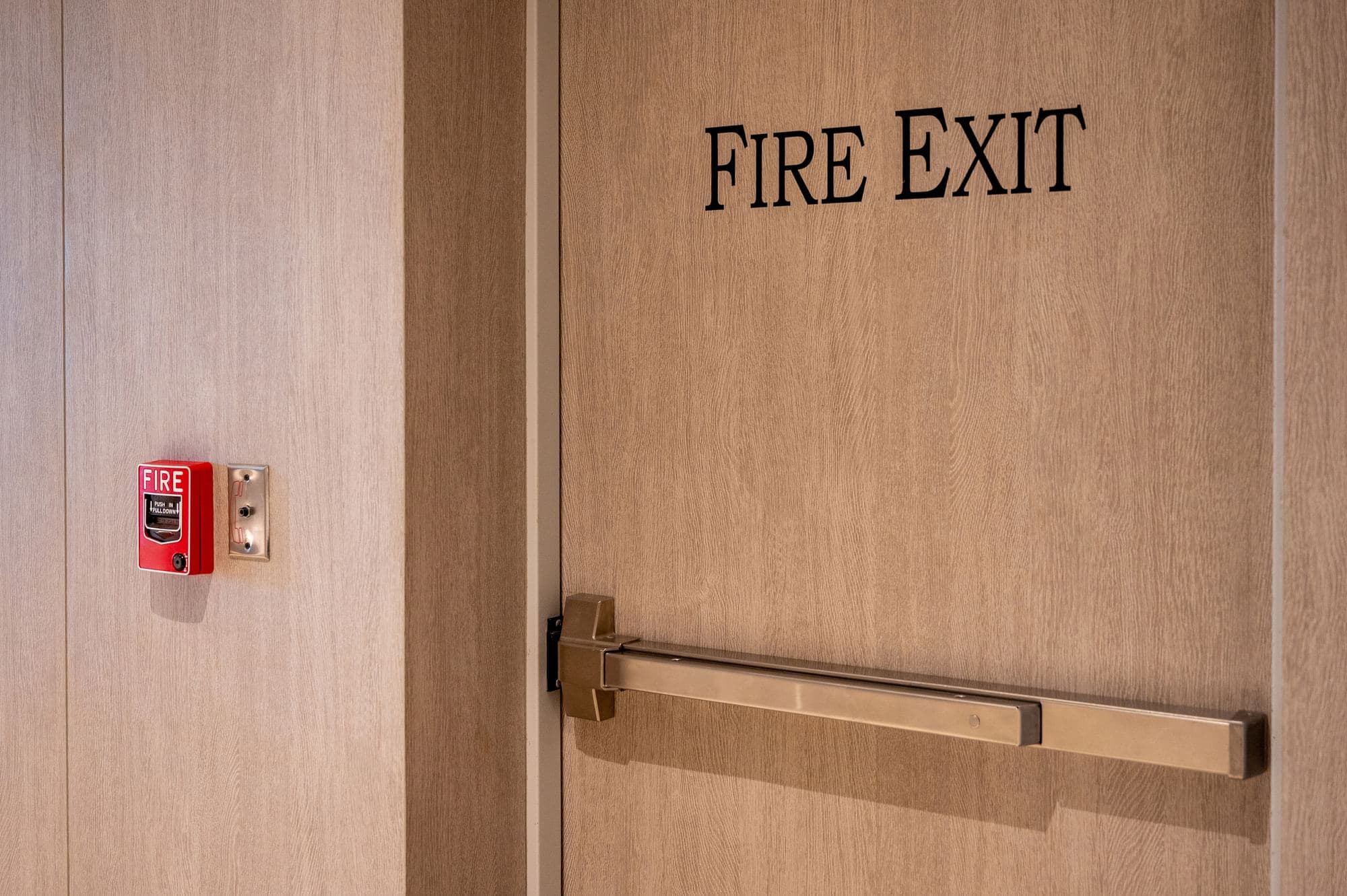
Once the routes are established, they must remain usable. OSHA requires exit routes to stay free and unobstructed. Exit doors must be unlocked from the inside, routes must be adequately lighted, exits must be marked, and non-exit doors must be identified where confusion is possible. Required safeguards such as alarms, fire doors, exit lighting, and sprinklers must remain in proper working order.
Those requirements are vulnerable to ordinary operating pressure. Temporary storage becomes routine. A cart narrows a path. A required self-closing fire door is propped open or its closing function is defeated. A layout change leaves an old sign pointing toward a route that no longer makes sense.
Walk the route from the employee's position to the final exit. Do it during an active shift, not only when the floor is quiet.
Know When OSHA Requires Written Plans
Emergency action plans and fire prevention plans are often discussed as if the same rule applies everywhere. It does not.
OSHA requires an emergency action plan when another OSHA standard triggers it. When required, the plan must address emergency reporting, evacuation procedures and route assignments, critical operations before evacuation, employee accounting, rescue or medical duties, and contacts for more information. Employers must review the plan with employees when it is developed or an employee is initially assigned to a job, when responsibilities change, and when the plan changes. Workplaces with 10 or fewer employees may communicate the plan orally.
A fire prevention plan also applies when another OSHA standard requires one. Its minimum elements include major fire hazards, hazardous-material handling and storage, ignition-source controls, needed fire-protection equipment, combustible-waste control, safeguards for heat-producing equipment, and the employees responsible for controlling fuel-source and ignition hazards. The same 10-or-fewer oral-plan allowance applies.
The practical risk is not only a missing plan. It is a plan that no longer matches who is responsible, what materials are present, or how the operation works.
Separate Extinguisher Inspection, Maintenance, and Use Policy
When portable extinguishers are provided for employee use, OSHA separates several controls that are often blended together. Extinguishers must be mounted, located, and identified so they are readily accessible, kept charged and operable, and returned to their designated places except during use.
The inspection cycle also has distinct parts:
- Visual inspection each month
- Annual maintenance check with the maintenance date recorded
- Hydrostatic testing at intervals that depend on extinguisher type
- Education for employees when extinguishers are provided for their use
- Additional training for employees designated to use firefighting equipment
An annual service tag does not prove the monthly checks happened. It also does not answer who, if anyone, may use the equipment.
OSHA permits bounded evacuation-only approaches when the applicable conditions are met. Other workplaces may designate certain employees to use extinguishers on incipient-stage fires. The policy, plan, equipment access, education, and training need to agree. Employees should not have to decide the company's fire-response policy while smoke is already present.
Alarm Testing Depends on the System
An alarm that makes noise is not necessarily an effective employee alarm. OSHA requires the signal to provide warning for the needed emergency action, be perceivable above ambient noise or light levels, and be distinctive and recognizable. Tactile devices may be used for employees who would not otherwise recognize audible or visual alarms.
Testing frequency is not universally annual. Non-supervised employee alarm systems must be tested every two months for reliability and adequacy. Supervised systems must be tested at least annually. The OSHA testing interval depends on the employee alarm system. State Plan requirements and facility-specific occupancy or egress questions may require separate verification with the appropriate state or local authority.
Review whether employees on each shift can recognize the signal and know the action it requires. Include isolated work areas, high-noise locations, employees wearing hearing protection, and people who may need another signal method.
Federal OSHA Is the Starting Point
Federal OSHA does not settle every fire-safety question for every facility. OSHA-approved State Plans must be at least as effective as federal OSHA, and their standards may differ. State or local authorities may resolve facility-specific fire-code, occupancy, and egress questions.
That is why a national checklist should end with verification, not certainty. Confirm the OSHA program covering the workplace, then identify the state, local, occupancy, system, and authority requirements that apply.
Manage the Gaps Before the Next Inspection
A strong fire-safety review connects the written system to current operating conditions. Check the routes. Confirm plan applicability and employee roles. Separate monthly extinguisher inspections from annual maintenance. Verify who evacuates and who may use equipment. Test whether alarm signals can be recognized. Assign an owner and target date to each correction, then confirm the fix in the field.
GMG EnviroSafe can help your business compare written plans, employee responsibilities, extinguisher and alarm records, exit-route conditions, and corrective-action follow-through with the EHS requirements that apply to your facility.
Contact GMG EnviroSafe to schedule a practical fire-safety compliance review, and confirm state, local, occupancy, fire-code, and authority requirements with the appropriate jurisdictional sources.
Sources
(1) National Fire Protection Association, Celebrate NFPA Fire Prevention Week, October 4 to 10. https://www.nfpa.org/events/fire-prevention-week
(2) Occupational Safety and Health Administration, Fire Safety Standards. https://www.osha.gov/fire-safety/standards
(3) Occupational Safety and Health Administration, 29 CFR 1910.36, Design and Construction Requirements for Exit Routes. https://www.osha.gov/laws-regs/regulations/standardnumber/1910/1910.36
(4) Occupational Safety and Health Administration, 29 CFR 1910.37, Maintenance, Safeguards, and Operational Features for Exit Routes. https://www.osha.gov/laws-regs/regulations/standardnumber/1910/1910.37
(5) Occupational Safety and Health Administration, 29 CFR 1910.38, Emergency Action Plans. https://www.osha.gov/laws-regs/regulations/standardnumber/1910/1910.38
(6) Occupational Safety and Health Administration, 29 CFR 1910.39, Fire Prevention Plans. https://www.osha.gov/laws-regs/regulations/standardnumber/1910/1910.39
(7) Occupational Safety and Health Administration, 29 CFR 1910.157, Portable Fire Extinguishers. https://www.osha.gov/laws-regs/regulations/standardnumber/1910/1910.157
(8) Occupational Safety and Health Administration, 29 CFR 1910.165, Employee Alarm Systems. https://www.osha.gov/laws-regs/regulations/standardnumber/1910/1910.165
(9) Occupational Safety and Health Administration, State Plans Frequently Asked Questions. https://www.osha.gov/stateplans/faqs
(10) Occupational Safety and Health Administration, Clarification of OSHA Jurisdiction Over Entry Access and Exits at a Public School in Pennsylvania. https://www.osha.gov/laws-regs/standardinterpretations/2007-06-14