Distribution
Struck-By Hazards in Distribution Centers: Loading Docks, Moving Equipment, and Blind Spots
A forklift training card can document that an operator completed training. It does not show that the training and evaluation match your current dock, your traffic pattern, or the racking layout you changed last month. That gap between the paperwork and the floor is where risk builds.
OSHA reports that the most common warehousing injuries are musculoskeletal disorders and workers struck by powered industrial trucks and other material-handling equipment (1). The U.S. Bureau of Labor Statistics puts the warehousing and storage recordable injury and illness rate at 4.8 per 100 full-time workers in 2024, against 2.3 across private industry (2). So look at the dock, traffic flow, equipment condition, training, and supervision together rather than one at a time.
Loading Docks: Where the Moving Parts Meet
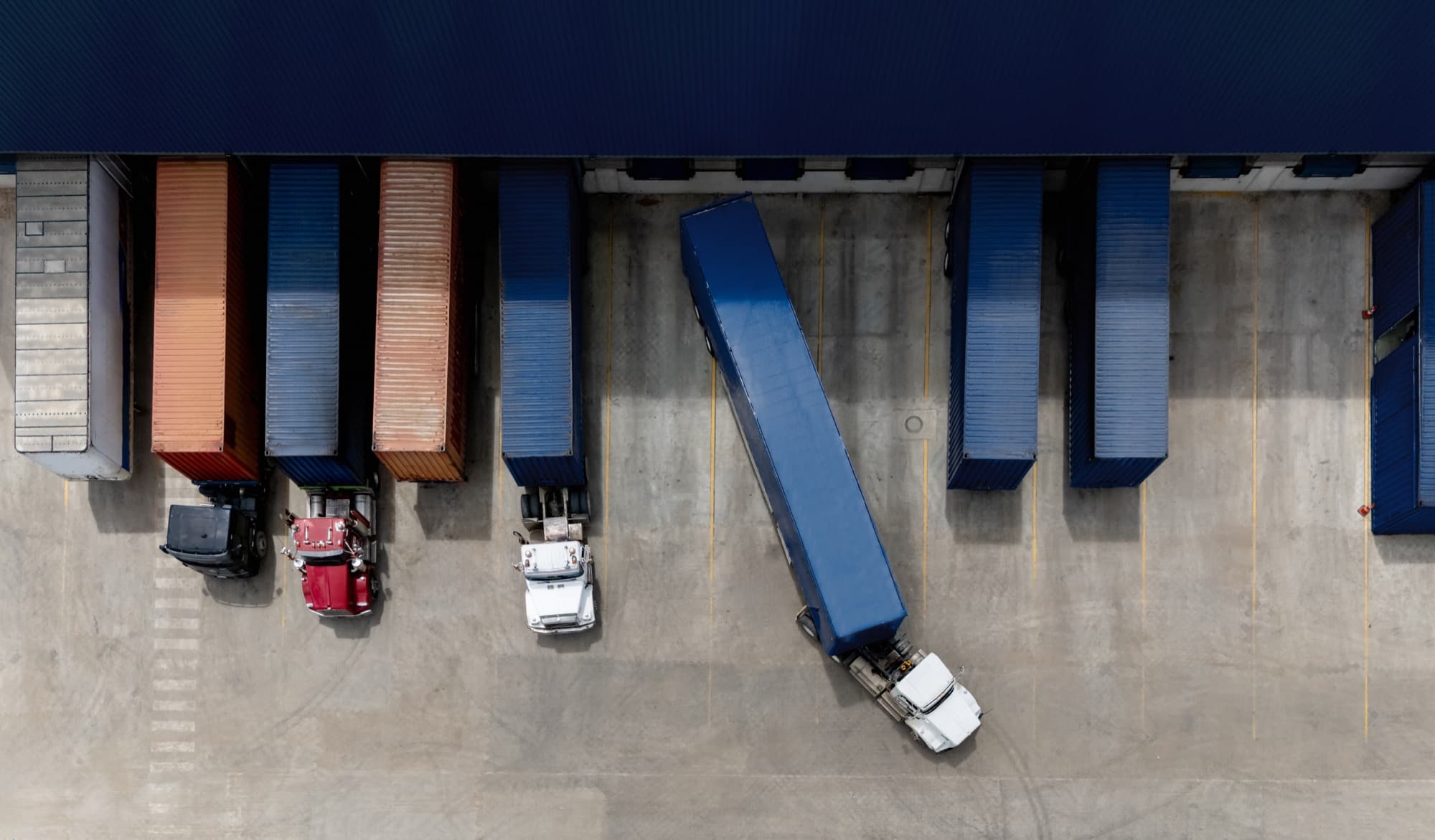
Trailers, forklifts, pallet jacks, dock plates, staged freight, and people all converge at the dock. Four common scenarios include:
- Trailer creep. A forklift driving in and out can slowly push the trailer off the dock, and the gap that opens can drop the forklift and its operator.
- Premature departure. A driver believes loading is finished and pulls away before the forklift is clear.
- Dock-edge falls and strikes. A forklift drives off an open edge, or a worker on foot is struck by a backing truck.
- Unstable dock plates. A plate that shifts, is unsecured, or is loaded past its rating can give way under a loaded forklift.
Under 29 CFR 1910.178, truck brakes must be set and wheel chocks placed under the rear wheels before a powered industrial truck boards the trailer (3). OSHA also allows a mechanical system that secures the trailer to the dock, where it gives protection equivalent to wheel chocks and is used as the manufacturer recommends (4). The same standard requires dockboards to be secured before forklifts drive over them, driven over slowly, and never loaded beyond their rated capacity (3). OSHA's dockboard standard, 29 CFR 1910.26, adds that portable dockboards must be kept from moving out of position (5).
Open dock doors create fall exposure when no trailer is present. OSHA generally requires protection where an employee is exposed to an unprotected side or edge 4 feet or more above a lower level (6). A limited exception covers employees on dockboards used solely for materials-handling with motorized equipment, where the fall exposure is not greater than 10 feet and those employees are trained (6). It is narrow, and it does not make an unused open dock door safe. State Plan rules may differ, so verify based on your facility.
Moving Equipment and Blind Spots
Away from the dock, forklifts, pallet jacks, and people share aisles. A loaded forklift needs more room to stop, and a raised or bulky load can block the operator's view. OSHA's rules speak to this directly: operators must look in the direction of travel, travel with the load trailing when it blocks the forward view, and slow down and sound the horn where vision is obstructed (3). Spotters may add another layer in tight areas. Rear-end swing catches people out too, because the back end swings opposite the turn.
Blind spots are a layout problem as much as a driver problem. Watch cross aisles and rack ends, dock doors and trailer entrances, pedestrian doors that open into equipment routes, and staging areas near corners. Noise makes them worse, because a constant alarm may be missed or ignored in a loud building.
OSHA does not specifically require backup alarms on forklifts, but an alarm the manufacturer installed cannot be removed (7). Separating pedestrian and forklift traffic is the first line of defense (8). OSHA also describes spotters and convex mirrors (8), along with cameras and internal traffic control plans that reduce how often equipment needs to back up (9). Those solutions are not required by any standard, so match them to your layout (9).
Falling loads create a separate struck-by risk. OSHA's materials-handling standard, 29 CFR 1910.176, requires safe clearances, marked aisles kept clear, and stable, secure storage (10). OSHA's warehousing guidance recommends inspecting racks, isolating damaged racking right away, and staying within capacity (11). Forklift contact can damage an upright even when no one reports it. Document any rack contact, and isolate and assess the racking before the bay goes back into use.
Training and Records That Match Your Floor
Forklift training must be specific to the truck and to your workplace: your traffic patterns, pedestrian areas, dock setup, and blind spots. OSHA also requires refresher training after unsafe operation, an incident, a near-miss, a change in truck type, or a workplace change that affects safe operation, plus an evaluation of each operator at least once every 3 years (3). A card from 2 years ago may not reflect a dock that was rebuilt last month.
The record matters too. Employers must certify that each operator has been trained and evaluated, naming the operator, the training date, the evaluation date, and who performed each (3). Those records are how you show the training and evaluations happened.
Your Loading Dock and Traffic Safety Checklist
Prevention works in layers: build separation into the space, write the rules that govern it, and train to your floor. Mirrors, alarms, lights, and vests support that system. They are not the system.
- Dock equipment. Plates secured, rated, and sound. Trailer securement in use, with wheel chocks or an equivalent mechanical system as applicable. Trailer floors checked before entry.
- Edges and openings. Dock edges marked, and open dock doors guarded when no trailer is present.
- Traffic separation. Marked walkways unobstructed, aisles clear, staged pallets not blocking sightlines.
- Visibility and speed. Convex mirrors clean and aimed, speed and stop signs visible at intersections.
- Equipment condition. Forklifts inspected before use, with horns and required safety devices working, including alarms, lights, and operator restraints where equipped. Racking checked for damage, with upright protection where needed. Damaged forklifts, dock equipment, or racking isolated until assessed.
- Records. Training and evaluation records complete, including the evaluation required at least once every 3 years. Near-misses reviewed, documented, and corrected.
How GMG EnviroSafe Helps You Stay Ahead
Struck-by exposure often involves several connected factors, including layout, traffic flow, equipment condition, training, and daily work practices. That is where a compliance partner helps. Depending on the level of support you choose, GMG EnviroSafe can help with:
- Site-specific assessments of docks, traffic flow, and pedestrian routes
- Powered industrial truck program reviews and blind-spot mapping
- Training built around your operation, including dock safety, forklift traffic, and blind-spot risks
- Documentation support for training records, assessments, and corrective actions
If you want a clear picture of where your program stands, we'll walk your floor with you. Contact us to schedule an assessment.
Sources
- OSHA. Warehousing (Overview). osha.gov
- U.S. Bureau of Labor Statistics. Warehousing and Storage: NAICS 493, Injuries, Illnesses, and Fatalities. bls.gov
- OSHA. 29 CFR 1910.178, Powered Industrial Trucks. osha.gov
- OSHA. STD 01-11-007, 29 CFR 1910.178(k)(1) and (m)(7): Mechanical Means to Secure Trucks or Trailers to a Loading Dock. osha.gov
- OSHA. 29 CFR 1910.26, Dockboards. osha.gov
- OSHA. 29 CFR 1910.28, Duty to Have Fall Protection and Falling Object Protection. osha.gov
- OSHA. Preventing Backovers, Standards. osha.gov
- OSHA. Powered Industrial Trucks (Forklift) eTool, Pedestrian Traffic. osha.gov
- OSHA. Preventing Backovers, Backing Safety Solutions. osha.gov
- OSHA. 29 CFR 1910.176, Handling Materials, General. osha.gov
- OSHA. Warehousing, Hazards and Solutions. osha.gov