Printing Industry Chemical Safety: Ink and Solvent Handling Risks Hiding in Plain Sight
In a print shop, the chemicals that carry the most risk are usually the ones handled most routinely, and the hazard rarely sits behind a locked door. It sits in the open rag bucket by the press, the spray bottle labeled only "wash," the safety data sheet binder nobody has opened since the last product change, the solvent can left uncapped over lunch, and the waste drum in the corner that no one has checked this week.
That's what makes ink and solvent handling worth a closer look. The chemistry isn't exotic, and the controls aren't complicated. The same inks, washes, and solvents show up across offset, flexography, gravure, and screen printing, all of which OSHA covers under its general industry standards (1). The risk builds during the most routine tasks, cleaning, wash-up, ink changeovers, and waste handling, which is exactly when familiarity makes it easy to stop noticing. The clearest way to see it is to follow a solvent through the shop, from the shelf to the air, and look at where the handling tends to slip and which rule is watching at each step.
Chemical inventory, SDS, and flammable liquid storage on the shelf
Everything starts with knowing what you actually have. OSHA's Hazard Communication Standard expects a written program, a current chemical inventory, a safety data sheet (SDS) for every product, labels that identify the hazards, and training for the people who handle the chemicals (2). In a print shop, that inventory is a moving target, because operators bring in new cleaners and aerosols, products get reformulated, and legacy containers gather in corners with faded labels. The common gap is simple: the binder no longer matches the floor.
OSHA updated the Hazard Communication Standard in 2024 and later extended the compliance dates (2). For print operations, the practical point is simple: as updated SDS and label information comes in from suppliers, employers need to keep workplace labels, the written HazCom program, and employee training current. A useful habit is to let every chemical change trigger three quick questions: do we have the current SDS, does the label match the hazard, and does anyone need updated training or different PPE? One worth-knowing wrinkle is that "it's just ink" is not a safe assumption, since OSHA has treated inks that are flammable or target-organ toxicants as hazardous chemicals when workers can be exposed during normal use or cleanup.
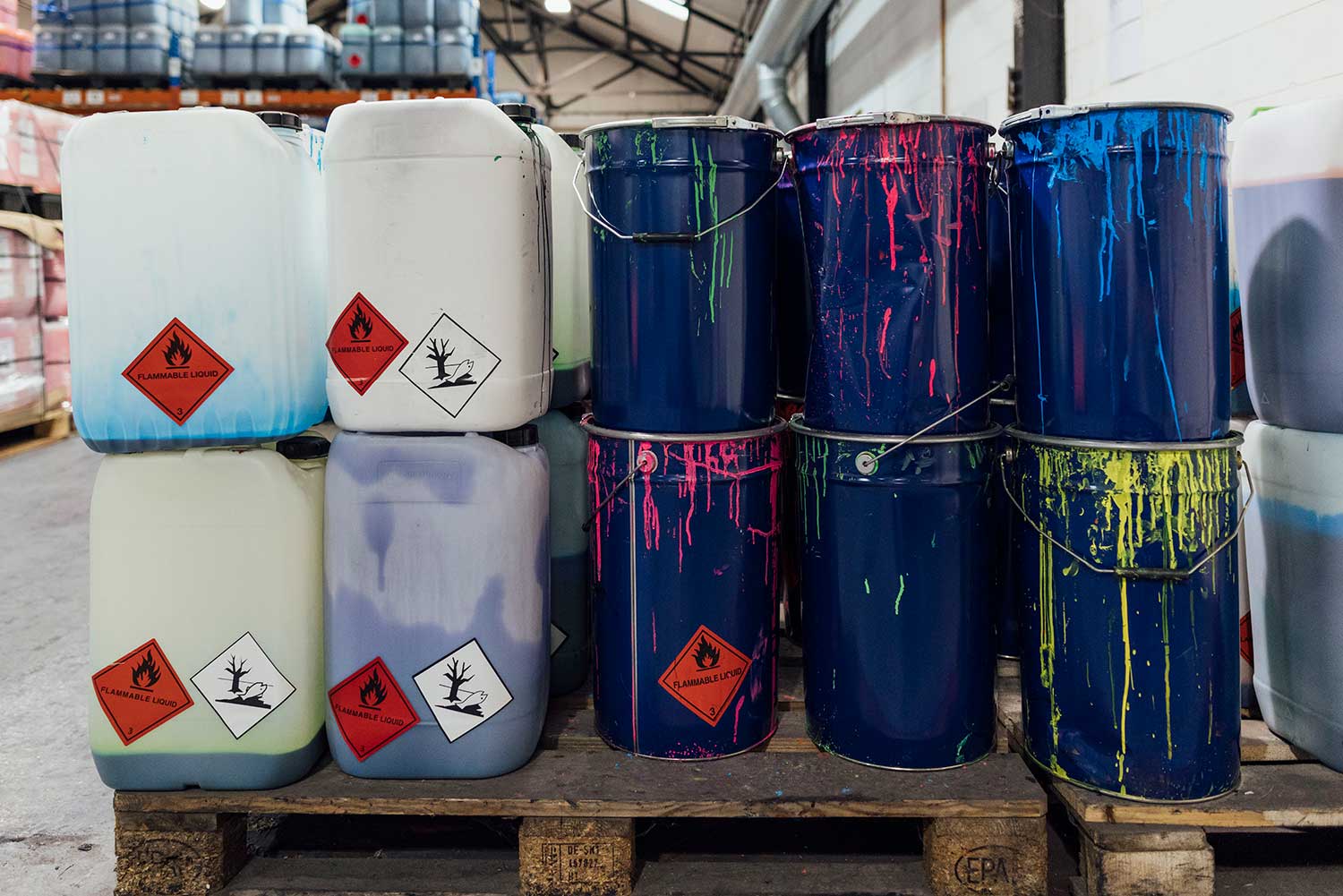
Storage is the other half of the shelf. Many inks, washes, thinners, and solvents used in print operations may be flammable or combustible, depending on the product and its SDS classification, which can put them under OSHA's flammable-liquids standard (3). That standard applies directly, and NFPA 30 or local fire code requirements may also apply depending on the jurisdiction. The rules keep containers closed when not in use, cap how much you can keep in a storage cabinet (no more than 60 gallons of Category 1, 2, or 3 flammable liquids in a single approved cabinet), and call for flammables to be separated from ignition sources (3).
Bonding and grounding may also be required or recommended during certain flammable-liquid transfer operations. The usual slips are partly used cans left open, waste drums left uncovered, cabinets treated as general storage, and containers crowded near a heat source. Sorting out what's on hand, getting the SDS library and labels up to date, and setting up storage that meets the standard is a typical starting point when GMG works with a print shop.
Solvent exposure and ventilation at the press
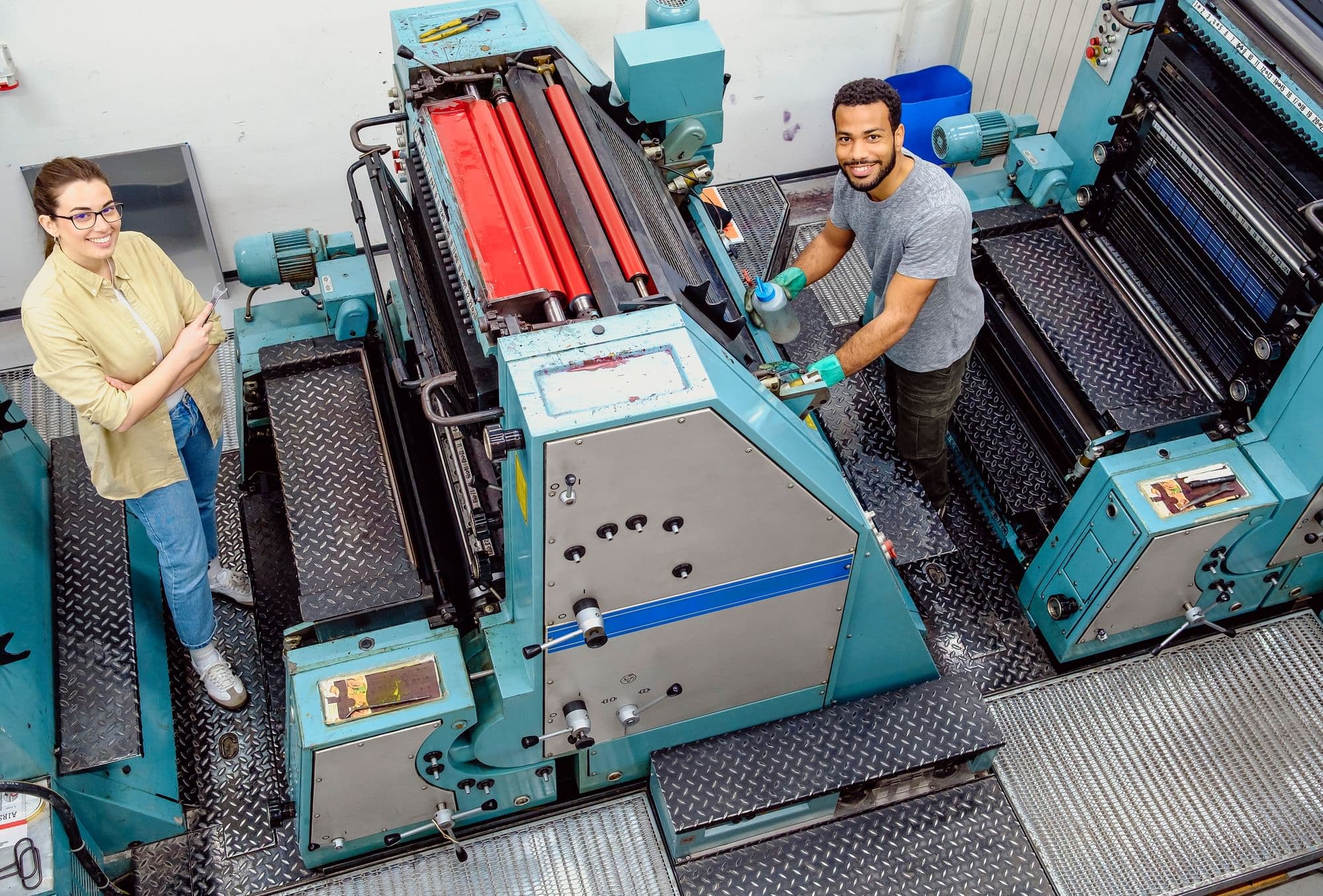
The highest-exposure moment in many shops isn't printing. It's the wash-up. NIOSH points out that airborne solvent exposure in printing comes mostly from evaporation during press cleaning, wiping rollers, blankets, plates, and trays with solvent mixtures that can contain several different chemicals (4). Workers often soak rags, wring them out by hand, and handle wet parts, which adds skin contact to the vapor exposure.
Two points are worth pulling out for anyone running a pressroom. First, a full-shift average can look fine while a short, intense task spikes well above safe levels, so a clean eight-hour number doesn't mean the wash-up is controlled (4). Second, the exposure doesn't stop when the wiping stops: NIOSH has found that solvent-soaked towels left out on a bench keep evaporating and adding to what workers breathe, and the fix is to use only what the task needs and drop used towels straight into a closed container (4).
The control that matters most here is ventilation, not PPE. Pulling vapor away at the source with local exhaust at cleaning and mixing stations does more than a respirator or an open door, both of which tend to move vapor around rather than remove it. And a line worth keeping in mind: a pressroom can smell completely normal to the people in it simply because they are used to it, which tells you nothing about whether exposure is being controlled.
PPE still matters, but it has to match the chemical and the task, since the glove material the SDS calls for, often nitrile or butyl rather than generic latex, depends on the specific solvent. Reviewing how cleaning is actually done, where the vapor goes, and whether the gloves and ventilation fit the chemicals in use is a large part of what an exposure assessment from GMG looks at.
Solvent-soaked rags and contaminated wipes in the rag bin
The rag bin is the clearest example of a hazard hiding in plain sight. Solvent- or ink-contaminated rags can create both fire and vapor hazards. Some oil-based residues may self-heat under the wrong conditions, while solvent-wet rags can release flammable vapors that ignite from a spark. The safer practice is the same for both: place used rags in approved, closed metal waste containers and empty them on a set schedule rather than letting them pile up (3).
There's a second layer here that's easy to miss, because used wipes are also a waste question. EPA's solvent-contaminated wipes rule can keep your wipes out of full hazardous-waste regulation, but only if you meet the conditions: store them in closed, non-leaking, labeled containers, make sure there are no free liquids before they leave the building, hold them no longer than 180 days, and keep records of where they go and how you confirmed there were no free liquids (5). Two catches trip people up. Any free liquid wrung out of the wipes is still hazardous waste, and disposable wipes contaminated with trichloroethylene don't qualify for the exclusion at all (5). State rules can also differ, so a multi-site printer shouldn't assume one wipe procedure covers every location. Setting up a rag and wipe process that satisfies both the fire concerns and the waste rules at once is a quick, high-value fix GMG often helps put in place.
Hazardous waste and generator status in the waste drum
Spent press wash, waste ink, still bottoms, contaminated absorbents, expired products, and aerosol cans can all be hazardous waste. EPA treats spent solvents as listed hazardous waste, and some waste inks may be hazardous because of ignitability, metals, solvents, or other constituents, depending on the formulation and contamination (6). How much of this you generate in a month sets your generator category: very small, small, or large quantity generator, and that category drives the storage, labeling, and disposal rules that apply (7).
The recurring problem in print shops isn't the drum that ships off-site; it's the counting. Wipes, sludge, still bottoms, expired chemicals, and the occasional cleanout event get overlooked, and a shop can land in the wrong generator category without realizing it. It's also worth knowing that the responsibility doesn't travel with the drum: even when a licensed hauler takes the waste away, the generator stays responsible from cradle to grave for how it was classified, labeled, and documented (7). A waste vendor can move the drum, but the shop still has to know what's in it and that the paperwork holds up. Walking the waste streams, confirming the determinations, and checking generator status against what's actually generated is a core piece of the support GMG provides.
Printing VOCs, HAPs, and air permit compliance
Most of what evaporates inks, fountain solution, and cleaners leaves as volatile organic compounds (VOCs) and, in some products, hazardous air pollutants (HAPs), concentrated at the press and the dryer. The federal Printing and Publishing air-toxics standard, the NESHAP, mainly applies to larger major sources running publication rotogravure, product and packaging rotogravure, or wide-web flexographic presses, so most small offset, screen, and digital shops are not subject to it (8). That doesn't make the airside irrelevant for a smaller shop. State VOC rules, a Title V or minor-source air permit, and monthly VOC usage recordkeeping can all apply depending on how much a facility has the potential to emit.
The point worth making for any print operation is that air applicability isn't a one-time decision. Changing inks, coatings, solvents, or control equipment, or simply running more volume, can move a shop across a permit threshold, and the recordkeeping is what shows you're under it. Reviewing VOC and HAP usage when a process changes and keeping the records that back up a permit are straightforward parts of staying ready, and they're the kind of regulatory support GMG provides.
Common ink and solvent handling gaps to check
A quick walk of the floor with these in mind tends to surface most of the everyday issues:
- Secondary containers labeled only "wash," "cleaner," or "solvent"
- An SDS binder that no longer matches the products in use on the floor
- Solvent cans or waste drums left open
- Used rags stored in open bins
- Wipe containers missing labels or accumulation start dates
- Gloves that aren't matched to the chemical the SDS calls for
- New inks, coatings, or cleaners added without a HazCom review
- Waste streams counted inconsistently from month to month
- VOC or HAP usage records not updated after a product or volume change
- Ventilation assumed to be adequate because the room "has always smelled this way"
Ink and solvent safety support for print operations from GMG EnviroSafe
Read end to end, the pattern is encouraging: the same small, concrete fixes close gaps across all of these rules at once. A current SDS library and labeled containers satisfy HazCom and make every other step easier. Closed metal cans emptied on schedule handle both the fire concern and the wipe rule. Honest waste counting keeps your generator status right and your air records straight.
For commercial printing operations, these everyday handling habits shape OSHA compliance, EPA compliance, fire prevention, and day-to-day worker safety all at once, and none of it requires reinventing the operation, just seeing the routine clearly and tightening the handling.
That's the work GMG does alongside print operations, from chemical inventory and SDS reviews to HazCom program updates, flammable storage and ventilation assessments, rag-and-solvent-wipe procedures, PPE selection matched to the chemicals in use, spill-response planning, and training for the people on the floor. If you want a clearer picture of how your facility manages ink, solvents, wipes, waste, and documentation, GMG EnviroSafe can help you review the process and close gaps before they become bigger issues. Get in touch with us today.
Sources
- OSHA. "Printing Industry" (Safety and Health Topics).
- OSHA. "Hazard Communication Standard Rulemaking" (29 CFR 1910.1200, 2024 update and compliance-date extension).
- OSHA. "1910.106 - Flammable Liquids."
- NIOSH. Health Hazard Evaluation: solvent exposure during printing and press cleaning.
- EPA. "Final Rule: 2013 Conditional Exclusions From Solid Waste and Hazardous Waste for Solvent-Contaminated Wipes."
- EPA. "RCRA in Focus: Printing."
- EPA. "Categories of Hazardous Waste Generators."
- EPA. "The Printing and Publishing Industry: National Emission Standards for Hazardous Air Pollutants (NESHAP)" (40 CFR 63 Subpart KK).