Construction
Forklift Safety on Construction Sites: Why Site Conditions Matter as Much as Operator Training
All-terrain forklifts move materials across rough ground, lift loads to upper floors, and keep work flowing across multiple trades. They are also involved in serious workplace injuries and fatalities each year. The same conditions that make construction forklift work productive can also make it hazardous.
Construction forklift safety is not the same as warehouse forklift safety. Jobsites change throughout the day, multiple trades share the same space, and loads are often irregular, oversized, or lifted to height. Operator certification alone is not enough. Real protection comes from a site-specific system that ties together training, daily inspections, traffic planning, ground-condition awareness, and ongoing supervision.
Why Construction Forklift Safety Can Be Higher Risk
The hazards on a construction site are less predictable than those in a controlled indoor environment, and several factors tend to combine in ways that raise the stakes.
Ground conditions are rarely consistent. Gravel, mud, slopes, ruts, and soft fill all affect stability. A route that is safe in the morning can be unsafe by afternoon after rain, soil movement, or a delivery that changes the staging area. Class VII rough terrain forklifts and telehandlers are built for these conditions, but stability still depends on boom position, side slope, tire condition, load weight, load center, and attachment type (1).
Multiple employers and trades share the same space. Forklift operators, subcontractors, laborers, delivery drivers, and other equipment operators often work side by side, and a traffic plan that protects one crew can still expose another if it is not communicated and enforced across all employers. Overhead hazards add another layer of complexity. Power lines, scaffolding, building edges, framing, and crane operations can all interfere with forklift movement and load handling, and telehandlers can reach high enough to contact overhead power lines, which can create severe electrical hazards (2).
OSHA Construction Forklift Regulations: A Quick Overview
Forklift use in construction is governed primarily by 29 CFR 1926.602, Material Handling Equipment, which requires industrial trucks to meet applicable ANSI design and operation requirements (3). Operator training under 29 CFR 1926.602(d) applies the same training and certification requirements found in the general industry standard at 29 CFR 1910.178(l) (4).
OSHA also recognizes ANSI/ITSDF B56.6 as the safety standard for rough terrain forklift trucks used on construction sites (1, 5). When these machines operate near overhead power lines, 29 CFR 1926.600(a)(6) sets the clearance requirements, generally requiring at least 10 feet of clearance from energized lines rated 50 kV or below, with greater distances required at higher voltages (2).
Forklift Injury and Fatality Data in Construction
National injury data does not separate rough terrain forklifts from other powered industrial trucks, so construction-specific counts for this equipment are limited. The National Safety Council groups forklifts and similar powered trucks together as a single source category, reporting 84 work-related deaths in 2024 and 25,110 nonfatal cases involving days away, restricted, or transferred work in 2023 to 2024 (6). Powered industrial trucks remain among OSHA's most frequently cited standards, with the most-cited sections involving safe operation, refresher training, and operator evaluation (7).
One construction-specific risk factor deserves particular attention: attachments. Rough terrain forklifts and telehandlers are often fitted with attachments, and sometimes with homemade or aftermarket devices the manufacturer never approved. Under 29 CFR 1910.178(a)(4), applied to construction through 29 CFR 1926.602(d), any modification or addition that affects a truck's capacity or safe operation requires the manufacturer's prior written approval, and the capacity and data plates must be updated to reflect the attachment (4). An unapproved attachment changes the load center, reduces rated capacity, and can move a machine toward tip-over even when the operator believes they are well within limits.
These patterns point to a clear takeaway. Forklift incidents are rarely caused by one missing checklist. They usually come from gaps in training, traffic planning, maintenance, supervision, or site coordination. On construction sites, those gaps can combine quickly because of rough terrain, elevated loads, unverified attachments, and constant interaction between workers and equipment.
Major Forklift Hazards on Construction Sites
Forklift Tip-Overs on Construction Sites
Tip-overs remain one of the most serious forklift hazards on construction sites. The construction-specific challenge is that multiple smaller factors often combine. A telehandler operating on a slight side slope, with a partially extended boom, on wet ground, carrying a load that is not centered, can move from stable to unstable quickly. No single condition causes the tip-over. The combination does.
Common contributors include traveling with raised loads, sharp turns, slopes and side slopes, soft or uneven ground, exceeding rated capacity, using the wrong load chart or attachment, and extending a telehandler boom without accounting for capacity reduction. Operators should keep loads low during travel, match the attachment and load chart to the specific machine, and pause work when ground conditions are no longer suitable.
Pedestrian Struck-By Incidents Around Forklifts
OSHA's guidance is clear that forklift traffic should be separated from pedestrians wherever possible, and that operators should slow down, stop, and sound the horn at intersections and areas with obstructed vision (8). Construction sites are especially vulnerable because workers often walk beside moving equipment, delivery zones shift throughout the day, and visibility is limited by loads, scaffolding, or temporary structures. Separation and clear traffic planning protect workers better than relying on operator awareness alone.
Falling or Shifting Loads During Construction Lifts
Construction loads are often irregular, long, heavy, bundled, or hard to balance. Lumber, trusses, pipe, roofing materials, masonry, drywall, and steel panels all present different handling challenges, and the risk increases when loads are elevated or moved across uneven ground. Loads should be secured, balanced, kept low during travel, and handled with a spotter when visibility is limited.
Improper Personnel Lifting with Forklifts and Telehandlers
This is one of the most important construction-specific issues. OSHA has interpreted that rough terrain forklifts may only be used as elevated work platforms when there are no other practical options, and that employers should first evaluate whether scaffolds, scissor lifts, aerial lifts, or ladders are feasible (9). When a forklift-supported personnel platform is used, OSHA's scaffold requirements under 1926 Subpart L may apply along with the equipment standards in 1926.602.
Forklifts should not be used to elevate workers unless the equipment, platform, site conditions, and procedures meet applicable OSHA and manufacturer requirements, and safer practical options have been ruled out. Informal practices such as standing on forks, pallets, or unsecured platforms create some of the highest-severity outcomes seen in construction forklift incidents.
Overhead Power Line Contact
Telehandlers and rough terrain forklifts can reach high enough to contact overhead power lines, especially when lifting materials to upper levels or working near utility corridors. Identifying power lines before forklift routes and lift zones are assigned is one of the most effective controls available. As a practical baseline, equipment should stay at least 10 feet from energized lines rated 50 kV or below, with greater clearance required at higher voltages (2).
Carbon Monoxide Exposure from Internal Combustion Forklifts
Internal combustion forklifts can generate dangerous carbon monoxide levels in enclosed work areas, which can lead to unconsciousness or death (10). This becomes a concern when forklifts operate inside partially completed structures, basements, garages, or enclosed shells before ventilation is fully established.
OSHA Forklift Operator Training Requirements for Construction
OSHA requires operator training to include three elements: formal instruction, practical hands-on training, and an evaluation conducted in the actual workplace using the type of truck the operator will use (4). A performance evaluation must be conducted at least once every three years.
Refresher training is required when an operator is observed operating unsafely, is involved in an incident or near-miss, receives an evaluation showing unsafe operation, is assigned to a different type of truck, or when workplace conditions change in a way that affects safe operation. On a construction site, that last trigger is especially important. New excavations, new traffic patterns, new overhead exposures, and new trades on site all qualify. A one-time certification at hire is not enough.
Daily Forklift Inspections on Active Construction Sites
OSHA requires industrial trucks to be examined before being placed in service, at least daily, and after each shift if used around the clock. Defects must be immediately reported and corrected (11). A meaningful daily inspection on a construction site covers more than the equipment.
Equipment checks should cover brakes, steering, horn, lights, backup alarm, seat belt, tires, forks, mast or boom, hydraulic hoses, fluid levels, load chart, data plate, attachments, and guarding. Site-condition checks should look at soft ground, ruts, mud, ice or standing water, slope, excavation edges, drop-offs, overhead obstructions, power lines, pedestrian routes, traffic congestion, material staging areas, blind corners, and temporary access roads. Inspection logs only protect workers when they reflect what is actually happening on site that day.
Telehandler Safety: Why It Is Not Just a Bigger Forklift
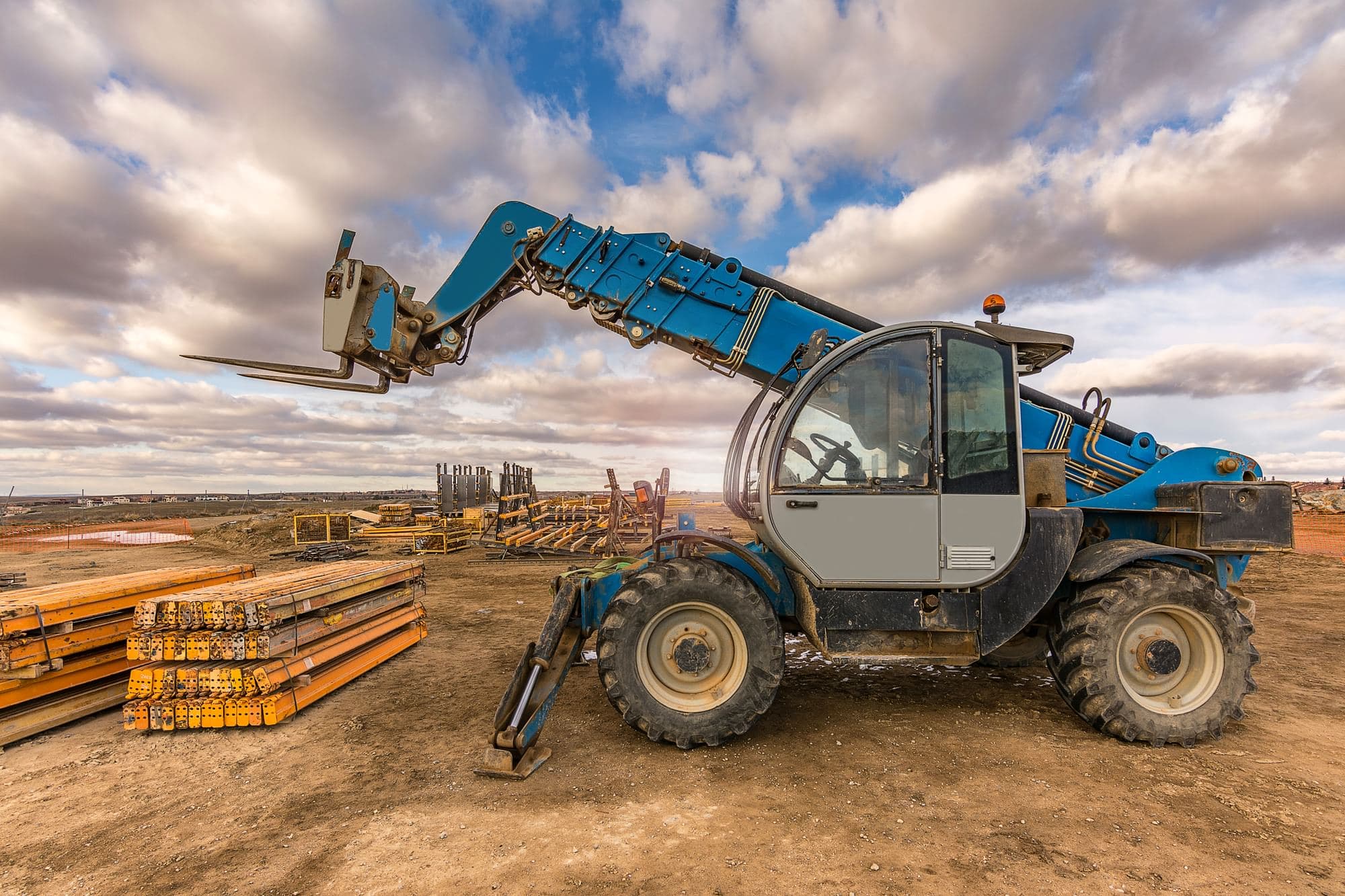
A telehandler is not just a bigger forklift. It is a lifting machine with changing capacity based on boom position, attachment, load, and terrain. Capacity drops as the boom extends, and it shifts again when an attachment is used. Load charts must match the specific machine and attachment, and the chart must be present and legible in the operator's station.
OSHA and the Association of Equipment Manufacturers have focused specifically on telehandler hazards, including ground conditions, machine mobility and overloading, and improper hoisting of employees (12). Side slope can significantly affect stability, and frame leveling, while useful, does not eliminate tip-over risk.
Pedestrian Safety and Traffic Control on Construction Sites
Forklift safety on a construction site cannot rely only on operator awareness. The hierarchy of controls applies, and engineering and administrative controls are far more effective than PPE alone.
Engineering controls include separating forklift routes from pedestrian paths, using barriers where feasible, setting up designated delivery zones and controlled crossings, installing mirrors at blind areas, and using proximity detection systems where appropriate. Administrative controls include a written jobsite traffic plan, posted speed limits, spotter rules, scheduled delivery windows, restricted access zones during lifts, pre-task planning, and clear site orientation for subcontractors and delivery drivers. PPE is the last line of defense, not a substitute for planning and separation.
Multi-Employer Coordination on Construction Worksites
Construction sites typically involve general contractors, subcontractors, delivery contractors, equipment rental companies, and temporary workers all sharing the same space. Forklift hazards routinely cross employer lines, and OSHA's multi-employer worksite policy can hold more than one employer responsible depending on who created, exposed, corrected, or controlled the hazard.
The practical takeaway is simple. Forklift safety on a construction site requires coordination across employers, not just within one company. A traffic plan that protects one crew may still expose another if it is not communicated and enforced site-wide.
Common Forklift Safety Compliance Gaps on Construction Sites
A few patterns show up most often during site assessments and tend to go unnoticed until an incident occurs. Common compliance gaps include:
- Training exists but is not site-specific to the equipment or conditions.
- No designated traffic patterns for forklifts and workers are established and enforced.
- Daily inspections are completed as paperwork only.
- Telehandler load charts are misunderstood or are not present for attachments.
- Forklifts are used to hoist personnel when other means are easily obtainable.
- Attachments are added without manufacturer approval or proper capacity verification.
- Ground conditions are not reassessed before lifts.
- Subcontractor coordination on traffic and lift plans is weak.
- Safe distances to overhead power lines are not properly identified.
- Near-misses occur but do not trigger investigation or corrective action.
Practical Forklift Safety Controls for Construction Operations
Before work begins, identify the forklift type, attachments, and operator training needed for the task. Confirm the load chart and data plate are present and legible, confirm any attachment is manufacturer-approved and reflected on the capacity plate, inspect the site for slopes, soft ground, drop-offs, overhead lines, and pedestrian exposure, create a forklift traffic plan with exclusion zones for lifts, and communicate routes to all affected trades.
During daily operations, complete a meaningful pre-use inspection, reassess travel routes as conditions change, keep loads low, and never travel with loads elevated higher than needed. Use spotters when visibility is obstructed, slow down at blind spots, avoid sharp turns or sudden stops, and stop to reassess when ground or weather conditions change.
Construction Forklift Safety Support from GMG EnviroSafe
GMG EnviroSafe supports businesses and contractor operations that rely on forklifts, telehandlers, and material handling on the jobsite. Our team can help review your forklift safety program, evaluate site-specific hazards, confirm training and inspection practices, support traffic and pedestrian controls, and strengthen coordination across multi-employer worksites.
The goal is more than compliance. It is a safer, more predictable jobsite where workers understand the plan and equipment is used the right way.
If your team needs support strengthening forklift safety practices, GMG EnviroSafe is here to help with clear guidance, site-specific assessments, and practical next steps.
---
Sources
(1) ANSI/ITSDF. (2021). B56.6-2021, Safety Standard for Rough Terrain Forklift Trucks. Retrieved from: https://www.itsdf.org/cue/b56-standards.html
(2) OSHA. (n.d.). 29 CFR 1926.600, Equipment (Subpart O, Motor Vehicles, Mechanized Equipment, and Marine Operations). Retrieved from: https://www.osha.gov/laws-regs/regulations/standardnumber/1926/1926.600
(3) OSHA. (n.d.). 29 CFR 1926.602, Material Handling Equipment. Retrieved from: https://www.osha.gov/laws-regs/regulations/standardnumber/1926/1926.602
(4) OSHA. (n.d.). 29 CFR 1910.178, Powered Industrial Trucks. Retrieved from: https://www.osha.gov/laws-regs/regulations/standardnumber/1910/1910.178
(5) OSHA. (n.d.). Powered Industrial Trucks Standards. Retrieved from: https://www.osha.gov/powered-industrial-trucks/standards
(6) National Safety Council. (2026). Work Safety: Forklifts, Data Details. Injury Facts. Retrieved from: https://injuryfacts.nsc.org/work/safety-topics/forklifts/data-details/
(7) Safety+Health Magazine. (2025). The most frequently cited standards in FY 2025. Retrieved from: https://www.safetyandhealthmagazine.com/27597-the-most-frequently-cited-standards-in-fy-2025/
(8) OSHA. (n.d.). Powered Industrial Trucks eTool: Pedestrian Traffic. Retrieved from: https://www.osha.gov/etools/powered-industrial-trucks/workplace/pedestrian-traffic
(9) OSHA. (2001). Standard Interpretation: Applicable Standards to Lifting Personnel on a Platform Supported by a Rough-Terrain Forklift. Retrieved from: https://www.osha.gov/laws-regs/standardinterpretations/2001-11-27
(10) OSHA. (n.d.). Powered Industrial Trucks eTool: Enclosed and Hazardous Areas. Retrieved from: https://www.osha.gov/etools/powered-industrial-trucks/workplace/enclosed-hazardous-areas
(11) OSHA. (n.d.). 29 CFR 1910.178(q)(7), Maintenance of Industrial Trucks. Retrieved from: https://www.osha.gov/laws-regs/regulations/standardnumber/1910/1910.178
(12) OSHA. (n.d.). Alliance with the Association of Equipment Manufacturers (AEM). Retrieved from: https://www.osha.gov/alliances/aem/aem