Employee Safety in Printing: Addressing Chemical Exposure Risks
Printing facilities run on chemistry. Inks, coatings, cleaning solvents, adhesives, and specialty chemicals make the work possible, and they also make worker protection a real, ongoing responsibility.
The challenge is that chemical exposure in printing is not always obvious. A shop can look clean and organized while still generating solvent vapor peaks during wipe-downs, changeovers, and end-of-shift wash-ups. NIOSH notes that airborne exposures in printing commonly come from evaporation at ink trays, rollers, and blankets, as well as during blending, thinning, and plate or press cleanup. (1) A facility can pass a visual walkthrough and still have a significant exposure problem hiding in its daily routines.
Understanding where the risks are, what OSHA expects, and what a practical control program looks like is the foundation of keeping your team protected.
Where Chemical Exposure Happens
Chemical exposure is not limited to one task or one moment in the shift. Across offset, flexo, gravure, screen, digital, and UV curing operations, the highest-exposure moments tend to cluster around a few repeatable activities.
Press cleanup and blanket washing is one of the most common high-exposure tasks because it involves open containers, saturated rags, and evaporation at close range. NIOSH published specific guidance for controlling cleaning-solvent vapors at small printers, emphasizing substitution, ventilation, work practices, and PPE as a combined solution rather than a single fix. (2)
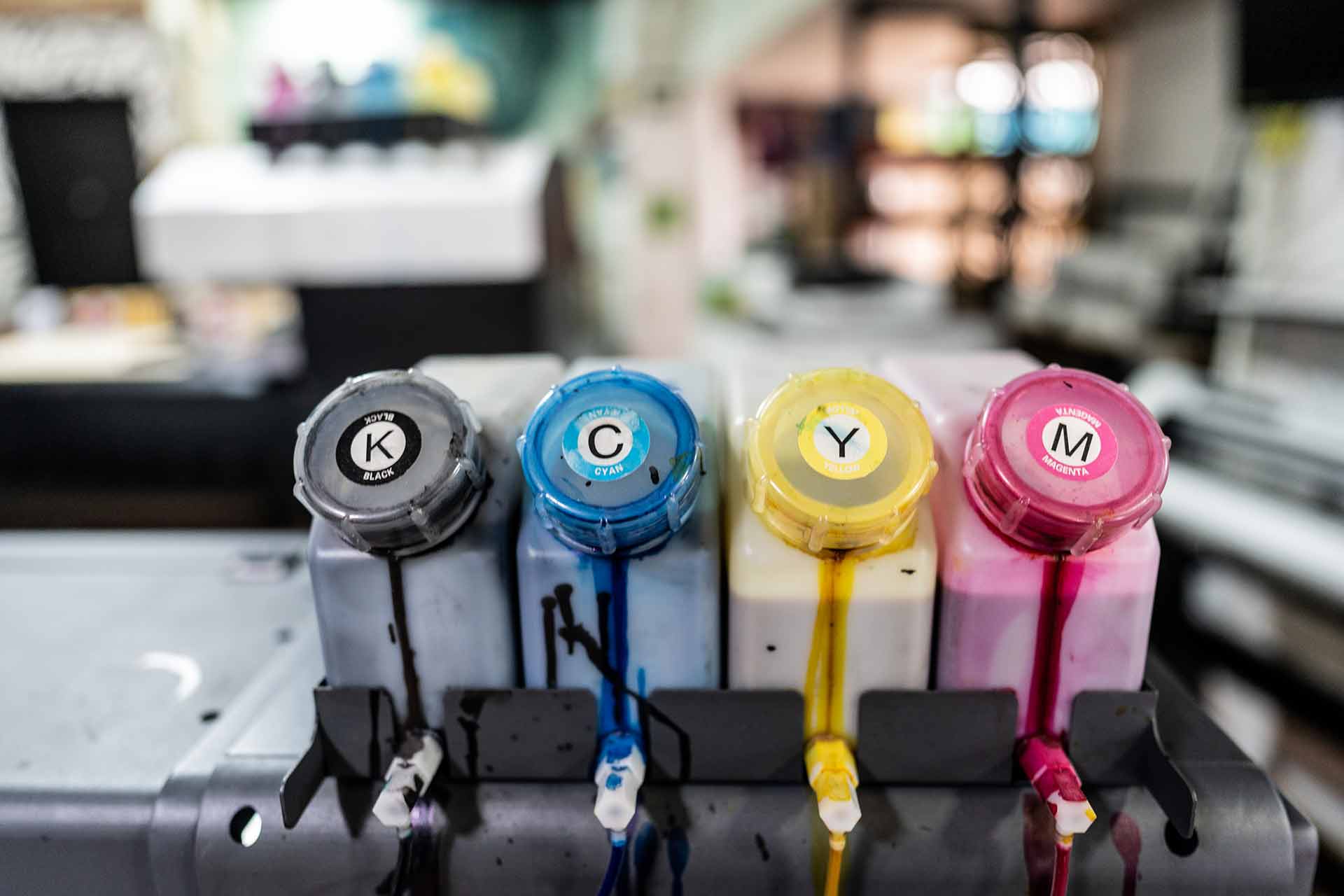
Ink mixing, thinning, and additive use can drive significant exposures when solvents are used for viscosity control, containers are left open, or ventilation is not targeted at the mixing point. Workers relying on "it doesn't smell that strong" as a guide to safety is one of the most common gaps we see in real facilities. (1)
UV inks and coatings reduce some solvent-related exposures but introduce their own chemical considerations. Uncured components during handling and cleanup can be potent skin and respiratory sensitizers. A complete hazard communication program, including SDS review, glove compatibility checks, and task-specific training, is still required under OSHA's Hazard Communication Standard (HazCom) for these systems. (3)(4)
Aerosols and convenience products often fly under the radar in safety programs. Spray adhesives, cleaners, and canned lubricants can create inhalation exposure during application, present storage and flammability concerns, and complicate waste management when discarded. They're also where labeling and accumulation practices tend to drift between shifts.
The Risk Categories That Matter Most
Solvents and volatile organic compounds (VOCs) are the most consistent chemical exposure concern in printing, particularly during cleaning and wash-up. OSHA's solvent hazard recognition guidance reinforces that employers have a clear duty to identify these hazards and communicate them to employees. (5) Health effects from repeated solvent exposure can include neurological impacts, skin damage, and long-term organ effects depending on the specific chemicals involved.
Sensitizers are a shop-dependent but serious risk. Some printing materials contain isocyanates, acrylates, and other sensitizing chemicals that can cause occupational asthma and allergic responses, even at relatively low exposure levels, once a worker is sensitized. OSHA addresses sensitizer controls specifically in its isocyanates guidance, and those principles apply broadly to any sensitizing chemistry in use. (6)
Skin contact is an underappreciated route of exposure. Even when airborne levels are well managed, dermal exposure can be significant in printing because hands are directly involved in wiping, cleanup, rag handling, and managing inks and coatings. Glove selection and hygiene practices matter as much as ventilation in these situations.
What OSHA Expects in a Printing Chemical Safety Program
Hazard communication has been the most frequently cited OSHA violation in printing operations for several years running. Common gaps include missing or incomplete written programs, missing SDSs, unlabeled secondary containers, and undertrained employees. (7)
OSHA's HazCom Standard requires printing facilities that use inks, solvents, adhesives, coatings, and cleaners to maintain a written hazard communication program, a complete chemical inventory, compliant container labeling, accessible Safety Data Sheets, and documented employee training. (3)(4) For multi-shift operations, this is a critical detail: if only the day shift receives the formal HazCom walkthrough, the program is not actually functioning. OSHA will look at all shifts.
Beyond HazCom, OSHA's expectations align with a clear hierarchy of controls. Engineering controls come first, work practices back them up, and PPE serves as the final protective layer rather than the primary one. NIOSH emphasizes local exhaust ventilation (LEV) in printing, specifically targeted at the points where emissions are generated during cleanup and handling. (8) Room ventilation alone does not capture vapors at the source.
Training also needs to be practical, not theoretical. It should cover the specific chemicals employees handle that week, not a generic chemical safety overview. Effective training helps workers identify label elements and pictograms, locate the right SDS sections for their task, recognize symptoms of overexposure, respond correctly to spills and splashes, and understand that "low odor" does not mean "low hazard."
Two Compliance Issues That Require Immediate Attention
The 2024 HazCom update. OSHA revised the Hazard Communication Standard in May 2024 to align with the 7th revision of the United Nations' Globally Harmonized System of Classification (GHS). Most printing employers need to update their written programs, workplace labels, SDSs, and employee training to reflect the new requirements. (3) If your program was last reviewed following the 2012 update, it is no longer current.
The methylene chloride deadline. EPA is banning methylene chloride in printing operations effective April 28, 2026. Until that date, OSHA requires documented exposure monitoring every time the chemical is used, and skipping that monitoring results in an automatic citation. Methylene chloride is still found in some blanket fixes and spotting fluids. If your facility uses it, a substitution plan needs to be in place now, not in the months before the deadline.
Controls That Actually Work
A strong chemical exposure program in printing is less about finding one big solution and more about executing the fundamentals consistently across all shifts and all tasks.
Substitution and product standardization reduce both exposure risk and program complexity. Standardizing blanket washes and cleaners, eliminating high-toxicity solvents where feasible, and requiring SDS review before any new product comes onto the floor are practical starting points. NIOSH includes substitution as a core element of its solvent vapor control guidance. (2)
Ventilation engineered for the work means local exhaust at the actual source of emissions, not just general airflow. Where LEV matters most is at wash-up stations, mix and thinning areas, and solvent-dispensing locations. (8)
Work practices that prevent peak exposures include keeping solvent containers closed when not in active use, using dispensing systems that reduce open pouring, replacing open rag buckets with approved closed containers, and scheduling high-solvent tasks when fewer workers are in the area when operationally possible. These practices reduce the exposure peaks that ventilation alone may not fully capture. (2)
PPE selected by chemistry, not by habit. Gloves should be matched to the specific solvents and reactive chemicals in use. Some glove materials degrade quickly with certain solvents, which can increase skin absorption rather than prevent it. Splash goggles and face shields are appropriate for tasks with splash potential, and respiratory protection may be needed where ventilation cannot keep exposures below occupational exposure limits.
Hygiene controls round out the program. Realistic handwashing practices, no solvent use for skin cleaning, breakroom separation from chemical handling areas, and appropriate uniform or laundry handling reduce both on-site and take-home exposure risk.
One more consideration: chemical exposure compliance in printing also connects directly to waste handling. Aerosols and convenience chemicals are common points where labeling, accumulation limits, and disposal practices drift across shifts. EPA's universal waste program provides a streamlined management pathway for certain common wastes, including aerosol cans. (9)(10) Getting exposure controls right and getting waste management right are often the same conversation.
Chemical Exposure Compliance Support from GMG EnviroSafe
At GMG EnviroSafe, we understand the specific operational realities of commercial printing. Our approach is practical and process-driven.
Our support commonly includes:
- Printing-specific chemical risk mapping by process and task, from press cleanup and wash-up to ink mixing and UV handling.
- HazCom program development and refresh, including written programs, chemical inventories, and labeling systems that hold up across all shifts.
- Task-based employee training matched to the actual chemistry in your facility.
- Ventilation and work-practice recommendations to reduce peak exposures at the source.
- Documentation management and OSHA readiness support.
- Ongoing program evaluation and regulatory guidance, including updates tied to the 2024 HazCom revision and the methylene chloride deadline.
The goal is a program that keeps your team protected, reduces lost workdays, and maintains consistent compliance with current enforcement expectations.
If you'd like support evaluating your chemical exposure risks or strengthening your printing safety programs, GMG EnviroSafe is here to help.
Sources
(1) Centers for Disease Control and Prevention (CDC), National Institute for Occupational Safety and Health (NIOSH). Personal Protective Equipment in Printing Operations. https://www.cdc.gov/niosh/engcontrols/ecd/detail35.html
(2) Centers for Disease Control and Prevention (CDC), National Institute for Occupational Safety and Health (NIOSH). Controlling Cleaning-Solvent Vapors at Small Printers. https://www.cdc.gov/niosh/docs/hazardcontrol/hc24.html
(3) Occupational Safety and Health Administration (OSHA). 29 CFR 1910.1200 Hazard Communication. https://www.osha.gov/laws-regs/regulations/standardnumber/1910/1910.1200
(4) Occupational Safety and Health Administration (OSHA). Hazard Communication: Overview. https://www.osha.gov/hazcom
(5) Occupational Safety and Health Administration (OSHA). Solvents: Hazard Recognition. https://www.osha.gov/solvents/hazards
(6) Occupational Safety and Health Administration (OSHA). Isocyanates: Overview. https://www.osha.gov/isocyanates
(7) PRINTING United Alliance. (2024). Top Ten 2023 OSHA Violations for Printing Operations. https://www.printing.org/content/2024/06/14/top-ten-2023-osha-violations-for-printing-operations
(8) Centers for Disease Control and Prevention (CDC), National Institute for Occupational Safety and Health (NIOSH). Local Exhaust Ventilation Systems in Printing Operations. https://www.cdc.gov/niosh/engcontrols/ecd/detail37.html
(9) U.S. Environmental Protection Agency (EPA). Universal Waste. https://www.epa.gov/hw/universal-waste
(10) U.S. Environmental Protection Agency (EPA). Increasing Recycling: Adding Aerosol Cans to the Universal Waste Regulations. https://www.epa.gov/hw/increasing-recycling-adding-aerosol-cans-universal-waste-regulations