Auto
Below the Surface: Building a Service Pit Safety Program for Quick Lube and Dealership Operations
A service pit is one of the most useful features in a quick lube or dealership service operation. It speeds up oil changes, gives technicians clean access to the underside of a vehicle, and keeps work moving. Because it is part of the daily routine, it can be easy to overlook. Employees walk around it every day, vehicles roll over it every day, and after thousands of routine cycles the open edge may no longer stand out as a hazard.
That is the real risk with a service pit. It is not that the pit is dangerous in some dramatic way. It is that a pit is not just a hole in the floor. It is a below-grade work area where four different areas of compliance overlap in one tight space: fall protection, air quality, fire and flammable vapors, and environmental controls. Many owners focus first on the fall hazard. The less-obvious gaps are usually the ones below the surface.
This article walks through what regulators actually expect around a service pit, where the less-obvious risks sit, and what a well-managed pit program looks like.
The Fall Protection Rule Most Owners Get Half-Right
Start with the hazard everyone already knows, because the rule is more specific than most owners realize. It is a common assumption that OSHA requires a guardrail around every open pit. That is not quite what the standard says. Under OSHA's walking-working surfaces rule, a pit less than 10 feet deep does not require a conventional fall protection system, but only if the employer limits access within 6 feet of the pit edge to authorized, trained employees, marks that 6-foot boundary, and posts compliant caution signs (1).
OSHA gives service pits their own path, but it does not accept "everyone knows it's there" as a control. The exception only holds if the access limits, markings, training, and signage are all actually in place. That is what owners tend to get half-right: the pit exists and people know about it, but the zone is not marked, the signs are missing, or no one can show which employees are authorized. It is also worth noting that the current requirement lives in 1910.28(b)(8), replacing an older provision many shops still reference.
The fall hazard itself is rarely dramatic. It usually happens during a transition, such as OSHA's own record of an employee who fell into a roughly 5.75-foot pit while using a foot to slide a cover back into place, fracturing a femur and tearing an ACL (3). The edge is most dangerous during movement: when covers are shifted, vehicles enter and exit, and attention is on the next task.
Practical controls follow directly from that: keep the 6-foot zone clear and marked, replace faded markings, define who can move pit covers and how, keep customers out of the service area, and keep tools and hoses away from the edge.
The Transition Moments Are Where Pit Controls Matter Most
Because the highest-risk moments are transitions rather than steady-state work, the everyday operating routine around the pit deserves as much attention as the markings and signs. This is where a pit that looks compliant can still produce an incident, and it is where day-to-day discipline does more than any single piece of equipment.
The moments to control are the ones where a vehicle, a cover, or a person is moving: a vehicle entering or leaving the bay, a cover being repositioned after a car pulls off the pit, or a bay door opening while someone works below grade.
A few practices address most of that risk. Establish clear vehicle entry and exit procedures with confirmation before any vehicle moves, and maintain reliable communication between upper-bay and lower-bay employees so no one is working under a vehicle that is about to move. Define exactly who moves pit covers and when, never by foot. Keep customers out of the active service area, and keep hoses, tools, drain pans, and waste containers away from the pit edge where they create trip hazards during those transitions.
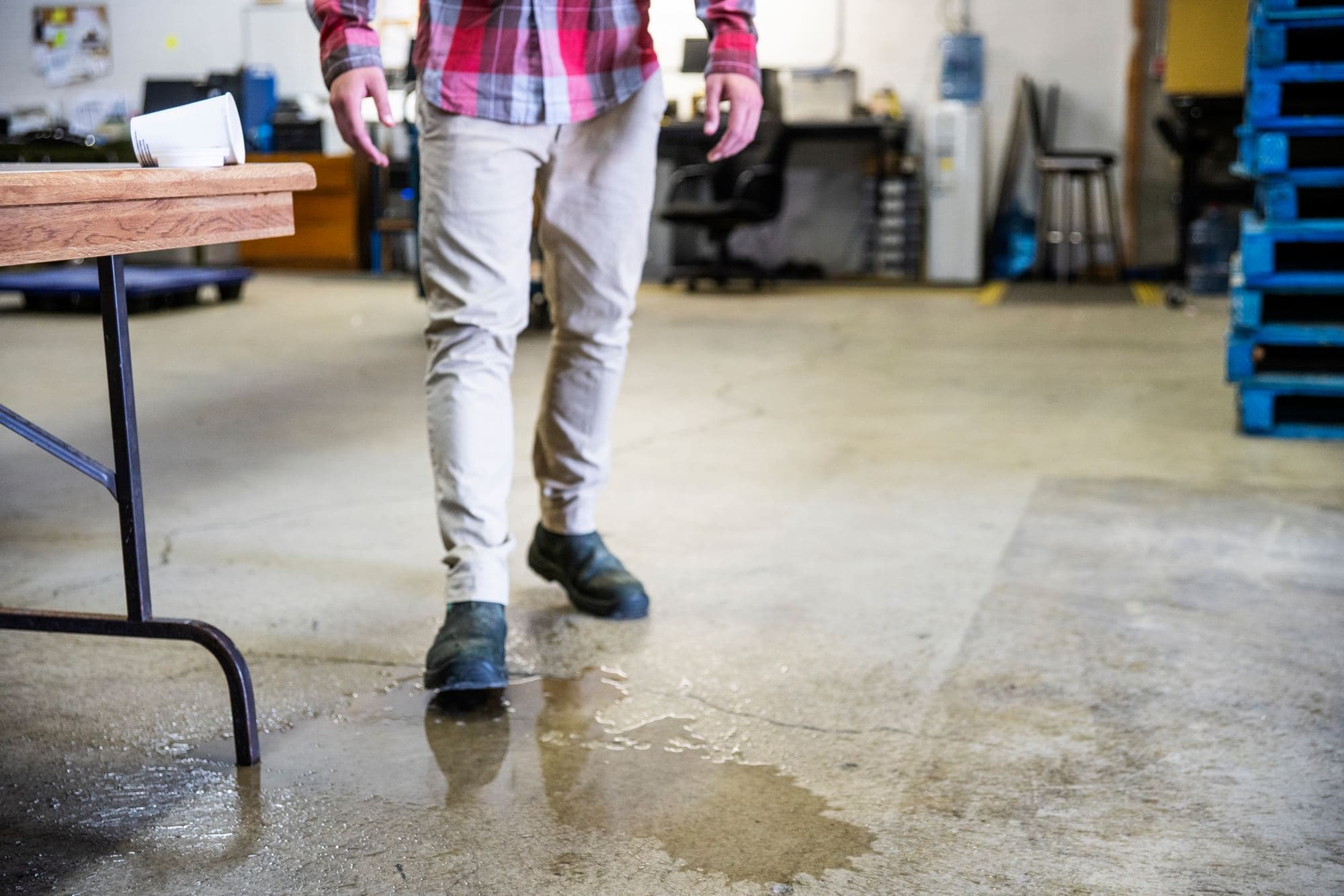
OSHA's walking-working surfaces rule reinforces the housekeeping side of this: surfaces must be kept clean, orderly, and, where feasible, dry, and hazardous conditions such as spills must be corrected before employees continue working in the area (2).
Air Quality: The Hazard That Does Not Announce Itself
Because a service pit is below grade, the air in it does not always behave like the air in the open bay. When engines run, when a vehicle sits over the pit, or when ventilation is weak or switched off, exhaust and vapors can build up in the space where the technician is working and breathing.
Carbon monoxide is the exposure to watch. It is colorless, odorless, and toxic, and it can accumulate rapidly in enclosed or semi-enclosed areas, even ones that appear well-ventilated, before anyone recognizes the symptoms (4). OSHA sets a permissible exposure limit for carbon monoxide of 50 parts per million (5). The danger is precisely that a worker cannot see or smell it: by the time the headache, dizziness, or nausea sets in, the exposure is already well underway.
A quick note on physics, because the common shorthand is wrong. Carbon monoxide does not "sink" into pits; its density is close to that of air, and it mixes rather than pooling at the bottom. The accurate concern is simpler: a below-grade work area with limited air movement and a running engine nearby is a place where exhaust gases can concentrate faster than employees expect. The controls are straightforward: limit engine run time over the pit, use exhaust extraction when a vehicle must run indoors, confirm the pit's ventilation is operating and maintained rather than assumed, consider air or personal monitoring where exposure is possible, and train employees to recognize carbon monoxide symptoms instead of relying on smell.
Flammable Vapors and Fire: Why Cleaning Method Matters
Here is the part of pit safety that is genuinely below the surface, and where the physics work against the operator. Gasoline and most flammable-liquid vapors are heavier than air. They do not disperse upward and away. They sink and collect in the lowest available space, which in a service bay is the pit, exactly where the technician stands and breathes.
This is not a matter of opinion or caution. Fire and electrical code requirements may treat below-grade areas in repair garages differently because flammable vapors can collect in low spaces, and OSHA's own flammable-liquids requirements address the storage and handling of these materials in the workplace (6). The practical implication for an owner is significant: ordinary shop lighting, extension cords, and power tools used in an unventilated pit can become ignition sources in a space where vapor can accumulate. Pit lighting and equipment should be suitable for that environment, and ventilation is not housekeeping. It is the control that keeps a flammable atmosphere from forming in the first place.
The risk is easy to underestimate because the pit does the concentrating for you. A modest fuel release that would disperse harmlessly in an open, well-ventilated bay can build to a dangerous concentration in a poorly ventilated pit, where the vapor has nowhere to go and the technician is standing in it.
This is why cleaning method matters more than owners usually assume. OSHA's incident records include a case at an automotive lubrication service in which a technician poured gasoline onto a lower-bay pit floor to clean off oil, spread it with a squeegee, and then used a wet/dry vacuum, one not approved for flammable liquids or hazardous locations, to collect the mixture. When he switched the vacuum on, it caused an explosion, and the technician was killed (7). The combination that produced it, a flammable liquid, an unrated piece of equipment, and an enclosed below-grade space, is exactly the combination a pit tends to create.
The controls are clear: never use gasoline or other flammable liquids to clean a pit floor, use approved cleaning materials and equipment rated for the environment, keep ignition sources controlled, keep Safety Data Sheets accessible and train employees on the chemicals they handle as OSHA's Hazard Communication standard requires (8), and keep an inspected, accessible extinguisher rated for the hazards present, positioned within the travel distance OSHA specifies for the class of fire risk (9).
Where the Fluid Goes: The Environmental Side of the Pit
The pit is also an environmental control point, and this is the piece a purely safety-focused review tends to miss. The question is not only what happens in the pit. It is where the fluid goes after it leaves.
Used oil, filters, absorbents, and shop rags accumulate around pit work, and they are regulated. EPA requires that used oil containers and tanks be labeled "Used Oil" and kept in good condition, not rusting, leaking, or deteriorating, and it specifically prohibits storing used oil in pits, lagoons, or unpermitted surface impoundments (10). A pit that becomes a de facto collection point for oily waste or standing fluid is not just a housekeeping problem; it can be an environmental violation.
Floor drains deserve particular attention. A drain or disposal system that receives fluids from vehicle repair or maintenance can be regulated by EPA as a motor vehicle waste disposal well, a category with its own requirements (11). Many operators genuinely do not know where their pit and bay drains lead. That uncertainty is itself the risk. Knowing where each drain goes, keeping oily waste and chemicals out of it, and maintaining any separators or interceptors are basic parts of managing the pit as a system rather than as a hole that collects whatever falls into it.
A Word on Confined Spaces: Evaluate, Do Not Assume
Service pits invite a common overstatement worth correcting, because getting it wrong in either direction signals a lack of expertise. Some sources declare that every service pit is a permit-required confined space. That is not accurate. OSHA's confined space definition requires that a space be large enough to enter and perform work, have limited or restricted means of entry or exit, and not be designed for continuous occupancy (12). OSHA does list pits among spaces that may have limited entry, but a typical service pit with an open top and a fixed stairway a worker can readily walk out of may not meet the "limited or restricted egress" criterion at all.
The correct posture is neither to dismiss the question nor to over-apply it. The employer's obligation is to evaluate the pit against the definition and document the determination. Where a pit's configuration restricts egress, or where a hazardous atmosphere could be present, the analysis changes and a permit-required confined space program may apply, including hazard evaluation before entry and measures to prevent unauthorized entry (12). The defensible question is not "Is my pit a permit space?" It is "Have I evaluated the conditions, documented the determination, and trained employees on the controls that actually apply?"
What a Managed Service Pit Program Looks Like
Pulling this together, a service pit is well-managed not when it looks normal, but when the controls around it are working, documented, and easy to verify. For a decision-maker, the practical test is whether the operation can demonstrate each of the following on request:
- Which employees are trained and authorized to work within 6 feet of the open pit
- That the 6-foot markings, warning lines, and caution signs are present and maintained
- That pit ventilation is operating and checked, not merely installed
- That cleaning procedures prohibit flammable liquids and that equipment is rated for the location
- That extinguishers are inspected and accessible, and Safety Data Sheets are available
- That used oil containers are labeled and sound, and that drain destinations are known and controlled
- That any confined space determination has been made and documented
- That housekeeping, inspections, and corrective actions are recorded
The difference between a compliant pit and an exposed one is rarely the pit itself. It is whether these controls operate as a system, every shift, rather than existing on paper.
How GMG EnviroSafe Helps
Most service pit gaps aren't due to owners who don't care. They happen because a below-grade work area touches four areas of compliance at once, and it's easy to manage the hazard you can see while missing the ones underneath.
That's where GMG EnviroSafe comes in. As an auto-industry EHS compliance partner, GMG helps quick lube shops and dealership service departments manage the full pit picture, not just one piece of it.
That includes fall protection, ventilation and air quality, flammable-vapor and fire controls, environmental waste handling, housekeeping and access procedures, confined space determinations, and the training and documentation that ties it all together.
A service pit is easy to stop seeing, and that's exactly what makes it worth a closer look. The real exposures are rarely at the visible edge in the floor.
They're in the ventilation, cleaning procedures, labeling, and drains that quietly fall out of alignment while daily work continues.
A pit is well-managed when those systems are current and ready to hold up under both a normal shift and an OSHA or environmental review.
If you would like a clear assessment of where your service pit safety program stands, GMG EnviroSafe can help you find what's below the surface before an inspection does.
Sources
(1) OSHA. 29 CFR 1910.28(b)(8), Duty to have fall protection: repair, service, and assembly pits less than 10 feet deep. https://www.osha.gov/laws-regs/regulations/standardnumber/1910/1910.28
(2) OSHA. 29 CFR 1910.22, Walking-working surfaces (general requirements: clean, orderly, dry where feasible; correction of hazardous conditions). https://www.osha.gov/laws-regs/regulations/standardnumber/1910/1910.22
(3) OSHA. Inspection Detail 309576536 (employee fell 5.75 feet into an oil-changing pit while using a foot to reposition a grate cover; fractured femur and torn ACL). https://www.osha.gov/ords/imis/establishment.inspection_detail?id=309576536
(4) National Institute for Occupational Safety and Health (NIOSH). Carbon Monoxide Hazards at Work. https://www.cdc.gov/niosh/carbon-monoxide/about/index.html
(5) OSHA. 29 CFR 1910.1000 Table Z-1, permissible exposure limit for carbon monoxide (50 ppm). https://www.osha.gov/laws-regs/regulations/standardnumber/1910/1910.1000TableZ1
(6) OSHA. 29 CFR 1910.106, Flammable liquids. https://www.osha.gov/laws-regs/regulations/standardnumber/1910/1910.106
(7) OSHA. Accident Detail 200901205 (technician killed in a gasoline explosion while cleaning a lower-bay service pit with gasoline and a wet/dry vacuum not approved for flammable material or hazardous locations). https://www.osha.gov/ords/imis/accidentsearch.accident_detail?id=200901205
(8) OSHA. 29 CFR 1910.1200, Hazard Communication. https://www.osha.gov/laws-regs/regulations/standardnumber/1910/1910.1200
(9) OSHA. 29 CFR 1910.157, Portable fire extinguishers. https://www.osha.gov/laws-regs/regulations/standardnumber/1910/1910.157
(10) U.S. Environmental Protection Agency. Managing Used Oil: Answers to Frequent Questions for Businesses. https://www.epa.gov/hw/managing-used-oil-answers-frequent-questions-businesses
(11) U.S. Environmental Protection Agency. Motor Vehicle Waste Disposal Wells (Class V injection wells). https://www.epa.gov/uic/motor-vehicle-waste-disposal-wells
(12) OSHA. 29 CFR 1910.146, Permit-Required Confined Spaces. https://www.osha.gov/laws-regs/regulations/standardnumber/1910/1910.146